
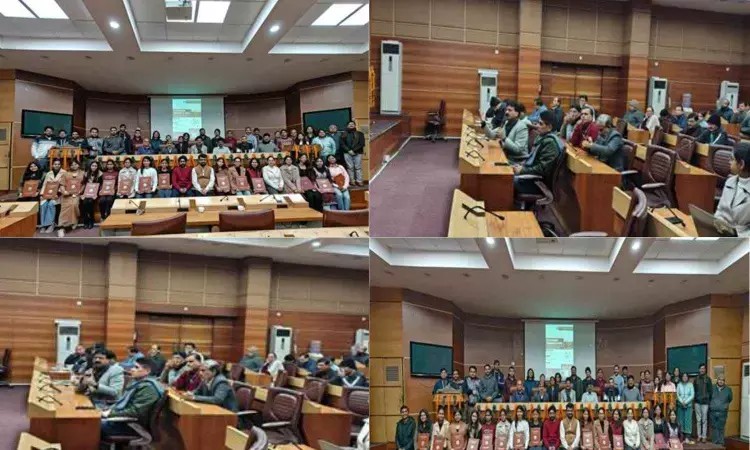

The internship programme witnessed strong interest from students, with 180 applications received from across the region. After a structured and merit-based screening process, 33 interns were selected for participation.
The selected students primarily came from engineering institutions in and around New Delhi, ensuring a strong technical foundation for the programme. CCRAS officials noted that the rigorous selection process helped identify candidates capable of contributing meaningfully to technology-enabled AYUSH research.
Hands-On Exposure to AI and Digital Research Tools
During the internship, participants worked on a diverse range of Information Technology projects aligned with the strategic objectives of CCRAS. These included AI-enabled applications in medicinal plant research, bioinformatics, and Prakriti assessment.
Interns also explored emerging areas such as medical imaging, posture detection technologies, and optical character recognition (OCR) for digitising ancient Ayurvedic manuscripts. These projects are central to CCRAS’s efforts to enhance digital documentation, evidence generation, and validation of traditional knowledge systems.
Interdisciplinary Learning and Expert Mentorship
The programme provided an interactive and interdisciplinary learning environment, allowing interns to integrate classical AYUSH concepts with modern computational tools. Continuous mentorship from domain experts played a crucial role in encouraging innovation and analytical thinking.
Officials said the exposure helped participants understand real-world research challenges while developing practical, scalable technological solutions tailored to AYUSH systems.
Leadership Highlights Strategic Importance of IT
The valedictory session was addressed by Prof. Rabinarayan Acharya, Director General of CCRAS, in the presence of Dr. N. Srikanth, Deputy Director General, along with other senior officials. The dignitaries appreciated the interns for their dedication and innovative contributions.
Prof. Acharya highlighted the strategic role of Information Technology, including Artificial Intelligence, in advancing the AYUSH sector. He emphasised that several applications developed during the internship have the potential to be validated and scaled through structured, project-based implementation.
Institutional Commitment to Capacity Building
The programme was coordinated by Dr. Rakesh Narayan V., Officer-in-Charge (IT), with support from Mr. Naman Goel, Mr. Sahil, Dr. Gagandeep Singh, and the technical staff of the IT Cell at CCRAS headquarters.
CCRAS officials stated that the internship programme reflects the organisation’s long-term commitment to capacity building, innovation, and institutional strengthening. By engaging young talent, CCRAS aims to create a robust research ecosystem that supports the mainstreaming of AYUSH through technology-driven and evidence-based approaches.