
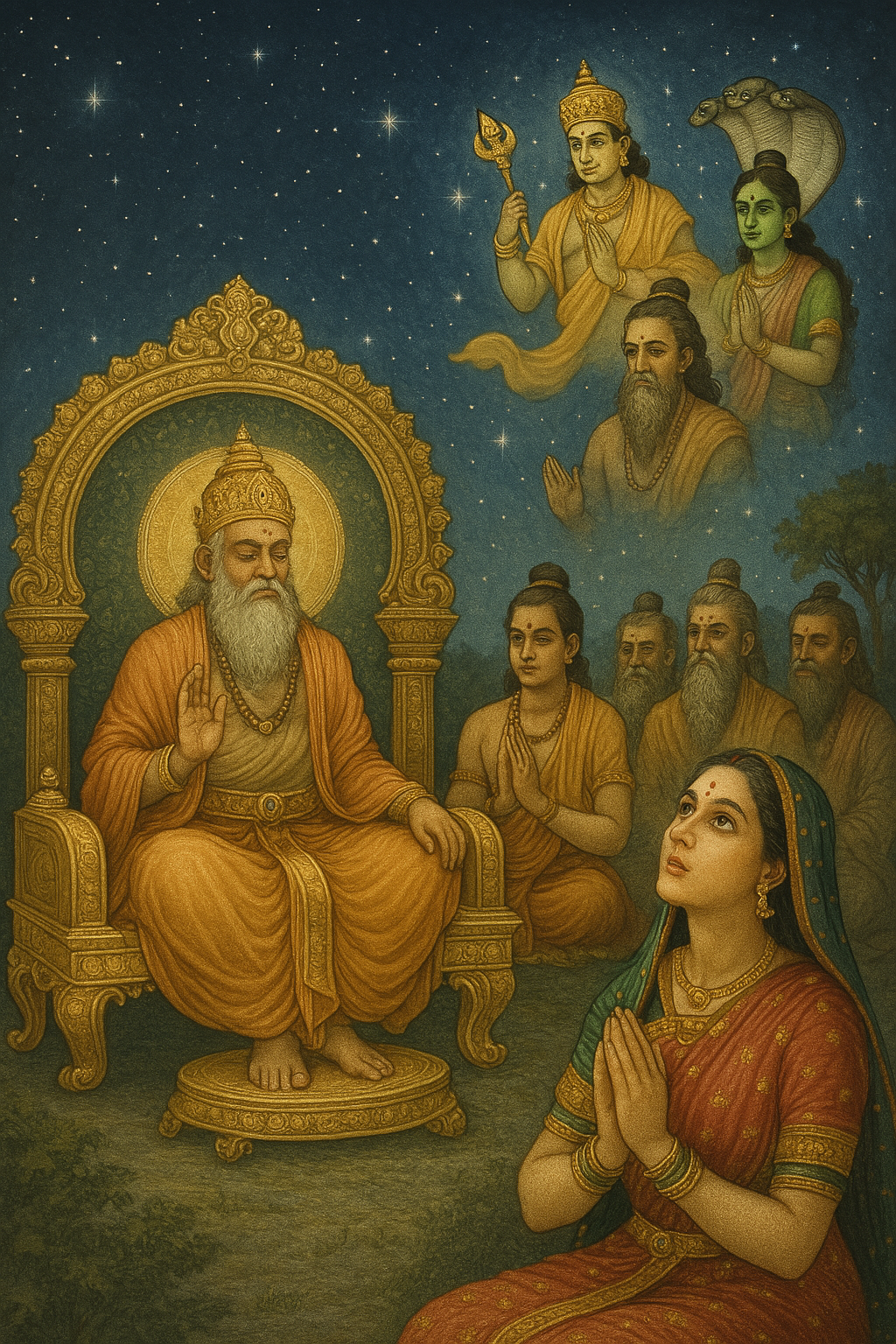
Chakshush Manu, recognized as the sixth lawgiver in the ancient Vedic cycle of Manvantaras, stands out as a historical figure revered not only for his role as a progenitor of mankind but also for his wisdom, spiritual insight, and connection with divine forces. He was born to the celestial being Chakshu, and is known for ushering in a spiritually enlightened era supported by advanced social organization.
During his rule, Chakshusha Manu fathered several prominent sons—Puru, Purusha, and Sudyumna—each of whom carried forward his legacy in different regions of the ancient world. He also had a daughter, Jyothismati, whose quest to marry the most powerful being led to a remarkable lineage. Following a divine chain of revelations—from Indra to Vayu, to Bhumavat, to Adishesha—she was ultimately reborn as Revati, destined to marry Balarama, the brother of Krishna.
His era was marked by strong celestial governance. The Saptarishis, or seven sages, included Sumedhas, Virajas, Havishmat, Uttama, Madhu, Abhinaman, and Sahishnu. The demigods of his time were the Apyas, and the ruler of heaven was Mantradruma.
The Vishnu avatar of this Manvantara was Ajita, who is sometimes equated with Chakshusha Manu himself. The name “Ajita” means “unconquered,” signifying a figure of great moral strength and divine authority.
An intriguing account from the Markandeya Purana states that in a past life, Chakshusha Manu was Ananda, the son of sage Anamitra. Raised by a king unaware of his true origin, Ananda later renounced royal life for asceticism. Pleased by his penance, Brahma blessed him to be reborn as Chakshusha Manu.
According to the Vishnu Purana, he married Nadvala, daughter of Prajapati Vairaja, and had ten noble sons, including Kuru and Abhimanyu, who played pivotal roles in the continuation of Vedic civilization.