
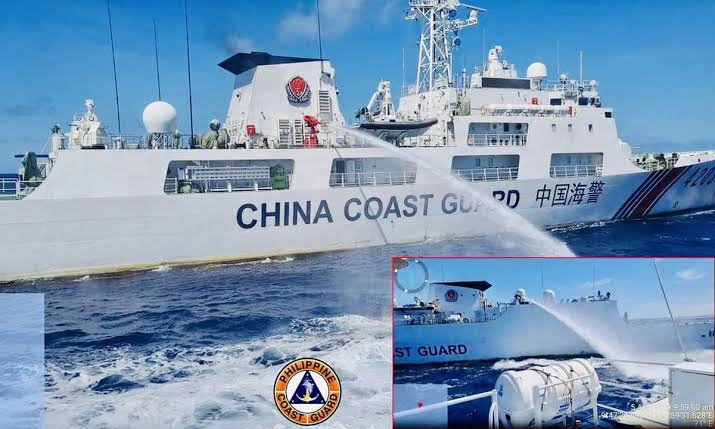
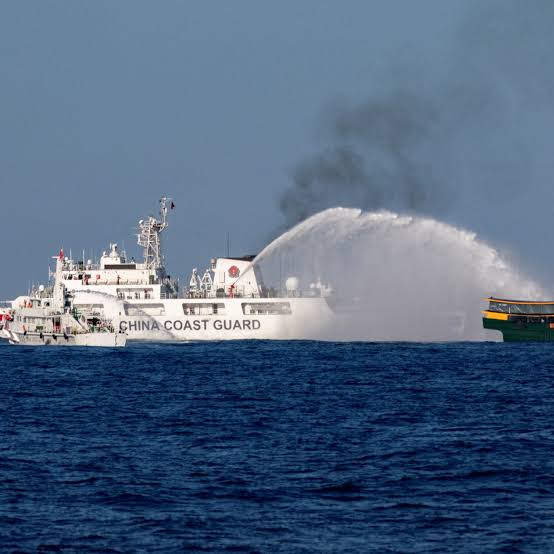

According to the Philippine Coast Guard, several Chinese coast guard ships intercepted around 20 Filipino fishing boats operating near Sabina Shoal, a fish-rich area located approximately 150 kilometres west of Palawan. Officials said Chinese vessels used water cannons and executed what they described as “dangerous blocking manoeuvres” to force the fishermen away.
Commodore Jay Tarriela, spokesperson for the Philippine Coast Guard, said three fishermen sustained injuries, including bruises and open wounds. He also confirmed that two fishing boats suffered serious structural damage after being hit by high-pressure water cannon blasts. The coast guard further alleged that Chinese personnel cut anchor lines in the disputed waters.
Videos released by Philippine authorities on social media showed forceful streams of water slamming into small wooden fishing boats, triggering widespread public outrage in the Philippines.
China Defends Its Actions
In response, the China Coast Guard said it had taken “necessary control measures” against Philippine vessels that it accused of illegally entering Chinese waters. Beijing claimed its ships issued warnings through loudspeakers and conducted external manoeuvring operations to drive the boats away.
China maintains that Sabina Shoal falls within its jurisdiction and has repeatedly asserted sovereignty over nearly the entire South China Sea, despite a 2016 international arbitration ruling that invalidated many of Beijing’s expansive maritime claims.
A Pattern of Rising Maritime Confrontations
The latest incident is part of a growing pattern of confrontations between Chinese and Philippine vessels in the region. In October, the Philippines accused a Chinese ship of deliberately ramming one of its government vessels near the Spratly Islands. Beijing rejected the accusation and blamed Manila for the collision.
In a separate incident earlier this year, a water cannon attack by a Chinese coast guard vessel shattered the bridge window of a Philippine fisheries bureau ship near the Beijing-controlled Scarborough Shoal, injuring one crew member.
Why the South China Sea Matters
The South China Sea is one of the world’s most strategically important waterways, carrying an estimated one-third of global maritime trade. It is also believed to hold vast reserves of oil, gas, and rich fishing grounds, making it a focal point of competing territorial claims.
Besides China and the Philippines, several other countries, including Vietnam, Malaysia, and Brunei, have overlapping claims in the region. India has consistently supported freedom of navigation and adherence to international law in the Indo-Pacific, as outlined by the United Nations Convention on the Law of the Sea (UNCLOS).
Diplomatic Implications Ahead
Analysts warn that repeated maritime incidents raise the risk of miscalculation and unintended escalation. With both China and the Philippines standing firm on their respective claims, diplomatic engagement and regional mechanisms will be crucial in preventing further deterioration.
As Southeast Asia watches closely, the latest clash underscores the fragile security environment in the South China Sea and the challenges of managing competing claims in one of the world’s most contested maritime regions.