

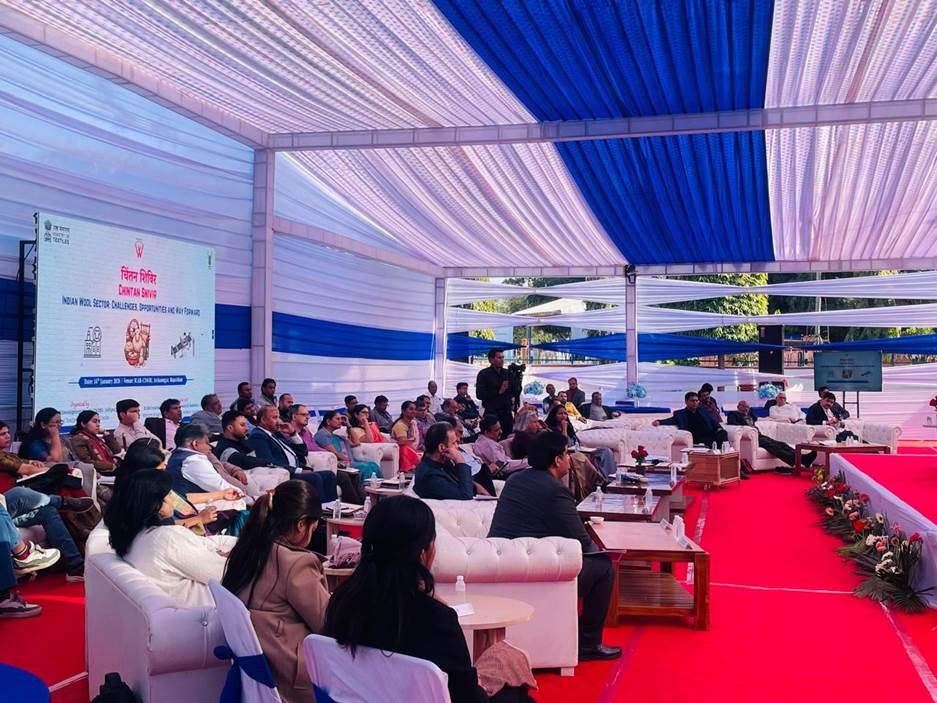

The programme was presided over by Smt. Neelam Shami Rao, Secretary, Ministry of Textiles, who attended as the Chief Guest. Smt. Padmini Singla, Joint Secretary in the Ministry, graced the occasion as Guest of Honour. Senior officials from several wool-producing states including Rajasthan, Himachal Pradesh, Jammu & Kashmir, Uttarakhand, Ladakh, Uttar Pradesh, Maharashtra, and Punjab actively participated in the discussions.
Representatives from research institutions, academic bodies, the Textile Committee, non-governmental organisations, and emerging start-ups also shared ground-level insights. The wide participation reflected the growing recognition of wool as an important livelihood-linked sector that requires coordinated policy and institutional support.
Focus on Integrated Value Chain Development
Four technical sessions formed the backbone of the Chintan Shivir. Expert panels deliberated on sheep rearing practices, wool production, pre-processing activities, research and development, sustainability, and value addition. Special emphasis was laid on strengthening Common Facility Centres (CFCs), improving market access, and developing branding strategies for Indian wool and woollen products.
Discussions highlighted the need to move beyond fragmented interventions and adopt an integrated value chain approach. Participants stressed that production, processing, product development, and promotion must be treated as interlinked components to enhance the competitiveness of Indian wool in domestic and global markets.
Key Messages from Policy Leadership
Summarising the outcomes, Smt. Neelam Shami Rao underlined that future research and development initiatives must be aligned with the economics of wool production and processing. She emphasised the critical role of farmer collectives and cooperatives, stating that public-private partnerships could significantly boost productivity and incomes in the wool sector.
In her keynote address, Smt. Padmini Singla highlighted the importance of end-to-end analysis for policy planning. She noted that strategic interventions across the value chain were essential for ensuring long-term sustainability and market relevance of Indian wool products.
Regional Concerns and Institutional Needs
Bringing a regional perspective, Shri Rudra Gaur, Secretary, Department of Animal Husbandry, Leh–Ladakh, spoke about the unique challenges faced by wool producers in high-altitude regions. He advocated treating wool on par with other agricultural commodities and called for a dedicated institutional mechanism focused exclusively on wool sector development.
His remarks resonated with participants from other hill and pastoral regions, where wool production remains a critical source of livelihood but faces constraints related to infrastructure, logistics, and market access.
Major Outcomes and Strategic Recommendations
The Chintan Shivir resulted in several forward-looking recommendations. These included strengthening pre-processing activities such as collection, grading, and scouring, establishing a Centre of Excellence for branding Indian wool, and setting up strategically located CFCs based on economic feasibility.
Participants also emphasised enhancing research and development efforts, promoting innovation-driven start-ups, and positioning Indian wool as a sustainable and value-added natural fibre in global markets.
Technology Exhibition Highlights Innovation
A technology exhibition organised alongside the event showcased diverse sheep and rabbit breeds, apparel-grade wool products, and technical textiles made from coarse wool. Research organisations and start-ups displayed innovations aimed at improving productivity and expanding product applications.
Dignitaries visited the exhibition, textile units, and the agribusiness incubation centre at ICAR-CSWRI. Dr. Arun Kumar Tomar, Director of ICAR-CSWRI, briefed guests on advanced woollen technologies, while Shri Gopal Singh Bhati, Executive Director of CWDB, outlined ongoing initiatives for the welfare of sheep farmers.