 Strengthening the Medicinal Plants Value Chain
The first technical session examined the role of government in developing the medicinal plants sector. Experts underlined the importance of conservation, scientific cultivation and linking traditional knowledge with modern research.
Prof. Vd. Rabinarayan Acharya, Director General of CCRAS, stressed the need for preserving medicinal flora while promoting evidence-based use of Ayurveda formulations. Officials from the Ministry of Agriculture and Farmers Welfare discussed convergence of horticulture schemes to support cultivation and allied activities.
NMPB officials detailed support mechanisms available for states and farmers, focusing on structured implementation, monitoring and evaluation to ensure transparency and measurable outcomes.
Traceability and Industry Linkages in Focus
A key highlight of the Chintan Shivir on Medicinal Plants was the panel discussion on supply-chain management and traceability. Industry representatives from leading Ayurveda and herbal companies shared concerns about raw material quality, aggregation challenges and standardisation gaps.
Participants stressed that digital traceability systems are critical to build consumer trust and improve export prospects. The panel also called for stronger farmer–industry partnerships, fair contract farming models and improved market access for cultivators.
The emphasis remained on creating a transparent farm-to-factory ecosystem that can meet both domestic demand and international regulatory standards.
Organic Certification and Insurance Support
Quality assurance and risk mitigation emerged as central themes during discussions on organic certification and trade facilitation. Experts highlighted the need to align domestic certification processes with global norms to enhance exports of medicinal plants and AYUSH products.
Officials from APEDA and the Ministry of Commerce elaborated on using digital single-window systems to simplify approvals. There were also calls for customized insurance products under existing schemes to safeguard farmers cultivating medicinal plants.
Participants agreed that easier certification, better access to trade information and financial protection will encourage more farmers to adopt medicinal plant cultivation.
CEOs Conclave: Lessons from 25 Years of NMPB
The evening CEOs Conclave reflected on NMPB’s 25-year journey and future direction. Former and current leaders reviewed policy milestones, implementation challenges and stakeholder engagement strategies.
The conclave recommended deeper integration of NMPB schemes with national missions in agriculture, forestry and public health. Experts also advocated for climate-resilient species cultivation and community-based conservation efforts to secure long-term sustainability.
Digital mapping, data-driven monitoring and human resource development across Regional cum Facilitation Centres (RCFCs) and State Medicinal Plants Boards (SMPBs) were identified as priority areas.
Best Practices from States and Regions
A parallel session showcased best practices from RCFCs and SMPBs across South, West, North, North-East, Central and East India. States presented innovative models in nursery development, farmer collectives, resource mapping and scheme convergence.
The expert jury appreciated successful grassroots initiatives and recommended scaling up replicable models nationwide. The diversity of agro-climatic zones was highlighted as a major strength for expanding medicinal plant cultivation.
Awards and Way Forward
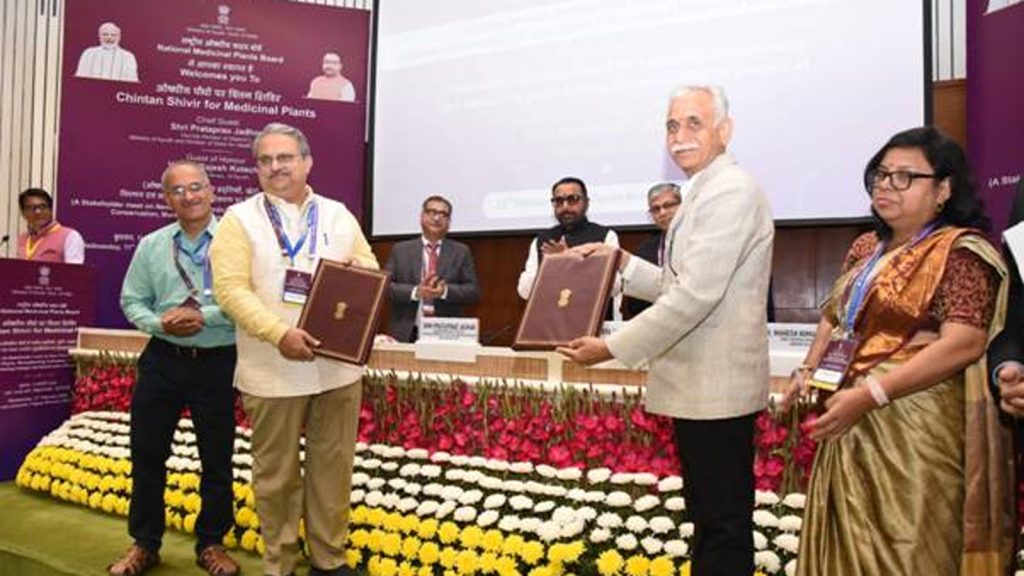
The valedictory session summarized actionable recommendations from the day’s discussions. Awards were presented to high-performing RCFCs and SMPBs in recognition of their contributions to sustainable and farmer-centric development.
The Ministry of Ayush reiterated its commitment to positioning India as a global hub for medicinal plants and AYUSH products. The outcomes of the Chintan Shivir are expected to shape future policy measures aimed at strengthening conservation, cultivation, processing and exports.