
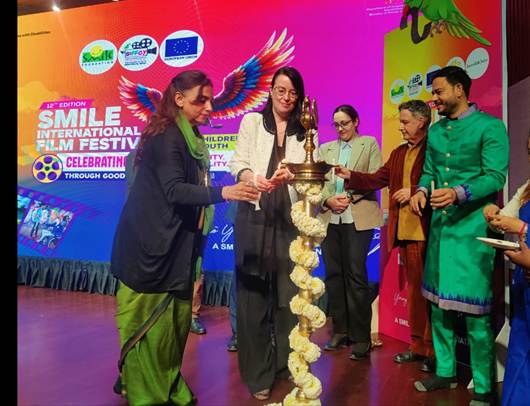
New Delhi: A powerful call to place inclusion at the heart of India’s cultural and social life resonated at the inauguration of the 12th Smile International Film Festival for Children & Youth (SIFFCY) on Tuesday, as speakers urged cinema to become a catalyst for accessibility and disability rights.
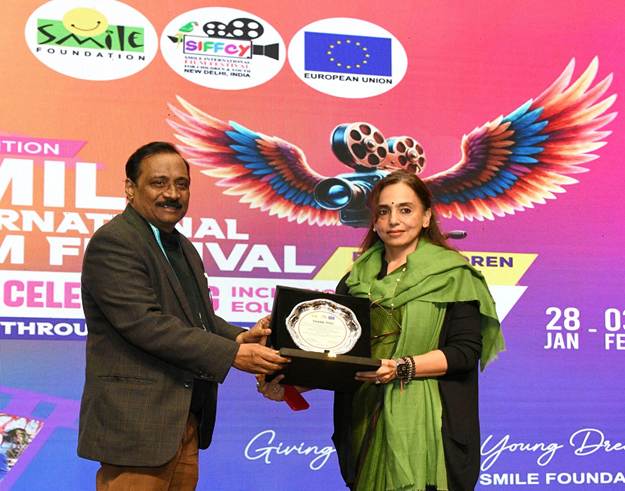

Setting the tone for the festival, Smt Manmeet Kaur Nanda, Additional Secretary, Department of Empowerment of Persons with Disabilities (DEPwD), stressed that inclusion must be understood not as an act of goodwill but as a matter of rights. Addressing policymakers, diplomats, filmmakers, educators and young audiences at the PHD Chamber of Commerce, she said that true inclusion demands a transformation of attitudes, not merely physical infrastructure.
Highlighting India’s disability landscape, Smt Nanda noted that the 2011 Census recorded 2.68 crore persons with disabilities, a figure widely acknowledged as an underestimation. She pointed out that nearly 80 lakh children with disabilities remain among the most excluded, often denied access to education, public spaces and cultural experiences such as cinema.
From Legal Mandate to Lived Reality
Referring to the Supreme Court’s 2021 judgment in Vikash Kumar vs UPSC, Smt Nanda underlined that reasonable accommodation is a constitutional obligation. She cautioned that denying accommodations whether extra time for children with dyslexia or access for children with autism amounts to discrimination rather than administrative convenience.
Drawing from her experience as a District Magistrate, she recounted instances where ramps led to storage rooms and accessible toilets remained locked, illustrating how token compliance often replaces genuine inclusion. According to her, inclusion must evolve from tolerance to acceptance, and eventually to celebration.
Cinema as a Tool for Empathy
Emphasising cinema’s unique power to shape perceptions, Smt Nanda said films can dismantle prejudice when persons with disabilities are portrayed as complete human beings rather than objects of pity or inspiration. She cited the film Little Big Dreams, created by children with special needs from Ladakh, as an example of inclusion achieved through creative agency.
She observed that representation becomes meaningful when children with disabilities are not just subjects on screen, but creators of their own narratives.
Global Voices, Shared Commitment
Reflecting the festival’s international character, Finland’s Ambassador to India, Mr Kimmo Lähdevirta, spoke of cinema’s ability to bridge cultures and connect societies. Reaffirming Finland’s long association with SIFFCY, he introduced Finnish short films and a children’s fantasy feature at the festival.
In a moment that delighted young audiences, he announced the screening of the iconic Moomins at SIFFCY for the first time, marking their 80th anniversary and sharing a treasured element of Finnish cultural heritage.
Building Cultural Bridges Through Children’s Cinema
Estonian Ambassador Ms Marje Luup described SIFFCY as a landmark platform in India’s children’s cinema ecosystem. She highlighted Estonia’s participation with six short films made by children, including works by Ukrainian refugee children currently residing in Estonia.
She noted that festivals like SIFFCY foster people-to-people connections and deepen cross-cultural understanding, drawing on Estonia’s long cinematic and animation traditions.
A Festival Rooted in Values
Reinforcing the festival’s philosophy, SIFFCY Chairman and Smile Foundation Co-founder Santanu Mishra said childhood is a formative phase where empathy and social awareness take root. Festival Director Jitendra Mishra added that SIFFCY creates a shared cultural space where young audiences encounter diverse global realities.
The festival, being held from January 28 to February 3, 2026, celebrates Inclusion, Diversity, Equity and Accessibility. Organised in partnership with DEPwD, the Ministry of Social Justice and Empowerment, and the EU Delegation to India, SIFFCY remains non-profit, non-ticketed and fully accessible.
With over 150 films from more than 35 countries, hybrid screenings across 100 locations nationwide, and prestigious awards including ECFA and CIFEJ honours, SIFFCY 2026 stands as a powerful reminder that inclusion is not optional it is essential.