

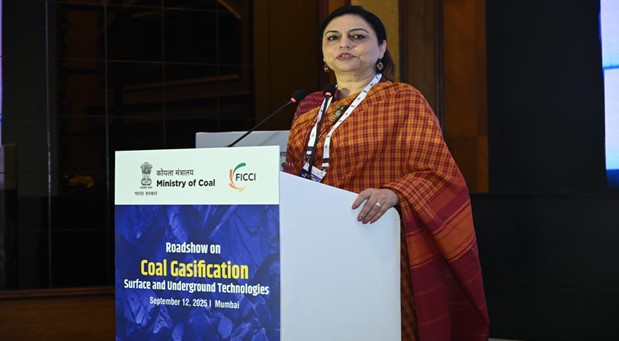

In her keynote, Additional Secretary and Nominated Authority Ms. Rupinder Brar celebrated India’s historic milestone of surpassing 1 billion tonnes of coal production. She reiterated coal’s critical role as the country’s predominant energy source, powering economic growth and national development. Ms. Brar highlighted coal gasification as a cornerstone of India’s energy transition, producing cleaner fuels, chemicals, fertilizers, and other value-added products while reducing environmental impact.
She called for scaling indigenous technologies, fostering research and innovation, attracting private investments, and adopting globally-aligned business models to ensure the long-term sustainability of coal gasification projects.
Technology Overview
The roadshow showcased both surface coal gasification and Underground Coal Gasification (UCG). Coal gasification converts coal into synthetic gas (syngas) containing hydrogen (H₂), carbon monoxide (CO), methane (CH₄), and carbon dioxide (CO₂). Syngas can be used to generate electricity, produce fertilizers, chemicals, and serve as feedstock for hydrogen.
UCG enables in-situ gasification of deep, unmineable coal seams using oxidants such as air, oxygen, or steam. Hydrogen produced through UCG can advance India’s clean fuel and hydrogen economy initiatives, while syngas and value-added products like methanol, dimethyl ether (DME), and synthetic natural gas (SNG) can be generated efficiently with minimal surface disruption and reduced water usage.
Environmental and Economic Benefits
UCG and surface gasification offer multiple advantages including cleaner fuel production, optimized use of unmineable coal reserves, lower environmental footprint, and reduced water consumption. These technologies support India’s commitment to sustainable energy, decarbonization, and circular economy principles, aligning with global best practices in environmental protection.
Ms. Brar emphasised that coal gasification not only contributes to energy security but also strengthens industrial competitiveness and encourages economic self-reliance.
Stakeholder Engagement and Policy Support
The Ministry of Coal has conducted extensive consultations with state governments, the Ministry of Environment, Forest and Climate Change (MoEFCC), the Directorate General of Mines Safety (DGMS), and the Central Ground Water Board (CGWB) to ensure robust safety standards. A dedicated committee has been formed to integrate UCG provisions into mining plans, streamline approvals, and incorporate these in upcoming coal mine auctions.
The roadshow included an interactive Q&A session, allowing participants to discuss policy frameworks, investment opportunities, and technology options with senior officials and experts, strengthening the ecosystem for coal gasification in India.
Future Prospects
The Ministry aims to make coal gasification, including UCG, a central pillar of India’s energy strategy. By combining innovative technologies with supportive policies, the government seeks to unlock new value streams from domestic coal reserves while advancing environmental sustainability.