
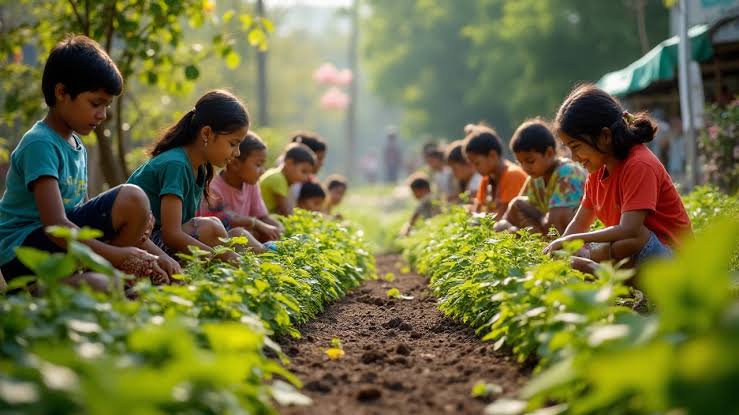

Under the Nagar Van Yojana (NVY), the government has established 620 Nagar Vans across 28 states and three Union Territories, creating urban and peri-urban green spaces that serve ecological and recreational roles. Since 2020–21, Rs. 50,784.64 crore has been released under the scheme. The School Nursery Yojana (SNY) complements NVY by engaging students in hands-on plant care and environmental education; Rs. 7.38 crore has supported school nursery activities so far.
Mass plantation drives and Mission LiFE
The ‘Ek Ped Maa Ke Naam’ campaign and other large-scale drives have contributed to planting over 261 crore saplings recorded on the MeriLife portal, including more than 45 crore in urban areas. Meanwhile, Mission LiFE (Lifestyle for Environment) has mobilised citizens through experiential learning, with more than six crore participants and 3.3 million LiFE-related activities reported, demonstrating measurable community engagement for sustainable lifestyles.
National Plastic Pollution Reduction Campaign (NPPRC)
To tackle single-use plastics, MoEFCC launched the National Plastic Pollution Reduction Campaign tied to World Environment Day 2025 an effort that included 69,000 pre-campaign events and roughly 2.1 million participants. The campaign extended through October 31, 2025, emphasising reduced plastic consumption in government offices and communities under the Swachhata Hi Seva umbrella.
Local outreach: NMNH, E-Waste drives and youth engagement
The National Museum of Natural History and its regional centres run cleanliness drives, nature walks and community art projects as part of Swachhata Pakhwada and other outreach. In partnership with the Department of School Education & Literacy and UNICEF YuWaah, the E-Waste Awareness and Reduction Campaign reached 70,000 students across 632 government schools and safely recycled nearly 5 tonnes of e-waste demonstrating targeted action on electronic waste streams.
Swachhta Action Plan and coastal clean-ups
Under the Swachh Bharat Mission, the inter-ministerial Swachhta Action Plan has been adapted to support bio-toilet installations at national parks and sanctuaries and to mainstream environmental education. The Ministry has also coordinated beach clean-ups across more than 80 beaches in three years, contributing to the designation of 13 Blue Flag beaches and strengthening coastal community awareness.
Education, eco-clubs and community arts
MoEFCC’s Environment Education Programme engages schools and colleges through eco-clubs and hands-on activities beach clean-ups, waste segregation demonstrations, street art, mural installations and green corridor projects. These initiatives aim to translate classroom learning into practice and cultivate long-term stewardship among youth.
Why community-driven actions work
Officials say community-led schemes succeed because they link national priorities with local ownership. Initiatives that use existing grassroots networks schools, SHGs, Anganwadis, postal workers and civil society help scale messages quickly and adapt solutions to local contexts. Regular monitoring, public reporting (such as MeriLife) and cross-ministerial partnerships underpin these efforts.
Next steps and scaling up
MoEFCC is continuing to prioritise community outreach, capacity building and multi-stakeholder partnerships to deepen impact. Officials told Parliament that the government will sustain campaigns, extend Mission LiFE activities and strengthen data-driven monitoring to ensure long-term gains in urban greening, plastic reduction and citizen-led environmental stewardship.