
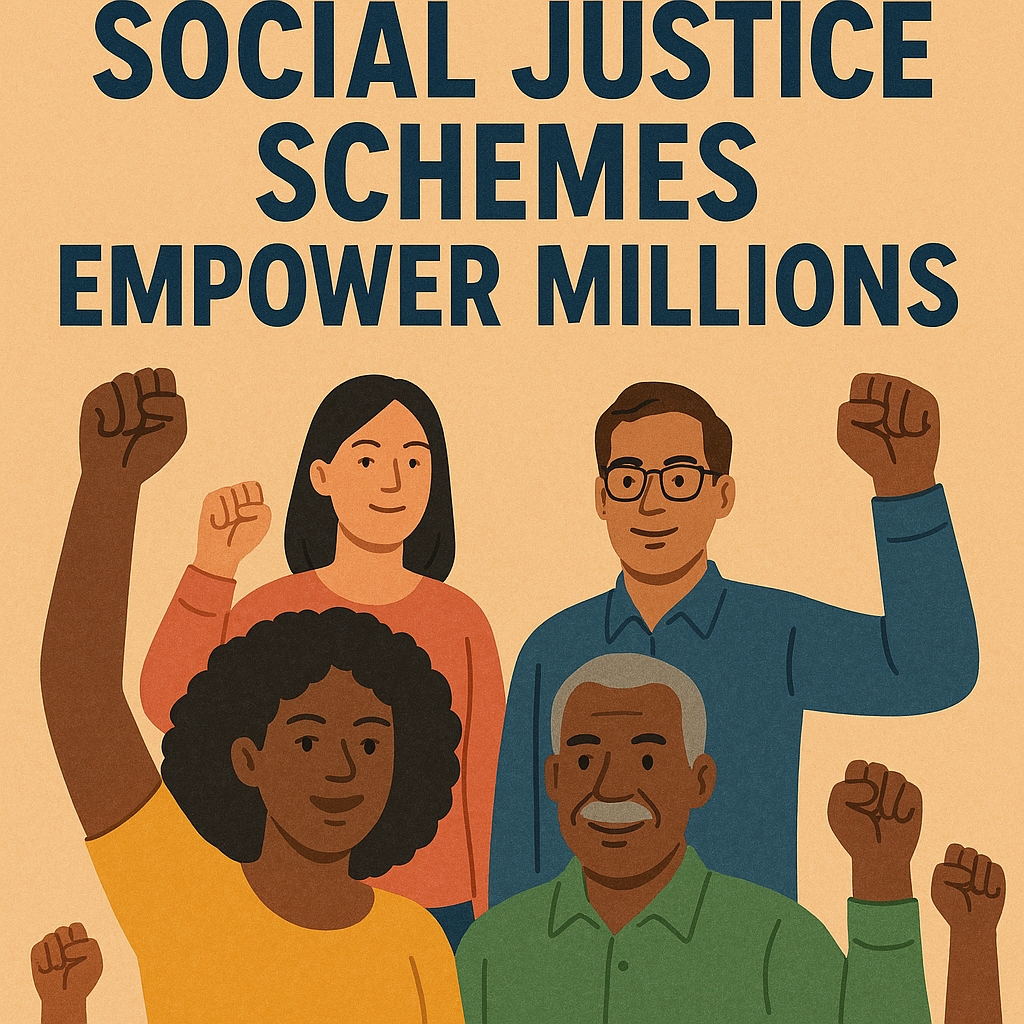

Education remained the cornerstone of social justice initiatives. Under the Pre-Matric Scholarships Scheme for SCs and others, the Department released ₹604.15 crore during FY 2025–26 (up to November), benefiting 30.74 lakh students. The scheme supported children from economically weaker SC families and those engaged in hazardous occupations, enabling them to continue schooling without financial hardship.
The Post-Matric Scholarships Scheme for SC students witnessed an even larger scale of support. An amount of ₹7,210.80 crore was disbursed to 61.71 lakh beneficiaries, helping students pursue higher education across universities and professional institutions. Complementary initiatives such as the Student Resource Centre and Mentorship Support Ecosystem further strengthened academic guidance.
SHREYAS-SC and Global Opportunities
The SHREYAS-SC umbrella scheme continued to nurture academic excellence. Under the Top Class Scholarship, over 4,150 SC students received ₹110.57 crore to study in premier institutions including IITs, IIMs and AIIMS. Free coaching support assisted aspirants preparing for competitive examinations, while the National Overseas Scholarship enabled students from low-income SC families to pursue higher education abroad.
In parallel, the National Fellowship for SC Students supported over 4,150 Ph.D. scholars, reinforcing research participation among historically disadvantaged communities.
Residential Education and Rural Development
The SHRESHTA scheme expanded residential education opportunities in SC-dominated areas. For the 2025–26 academic session, 2,915 students were admitted to 151 private residential schools, with ₹79.37 crore reimbursed toward school fees. Financial assistance also continued for NGO-run schools and hostels under Mode-II of the scheme.
Meanwhile, the Pradhan Mantri Anusuchit Jaati Abhyuday Yojana (PM-AJAY) focused on holistic rural development. Thousands of SC-dominated villages progressed toward becoming ‘Adarsh Grams’, while livelihood and infrastructure projects received over ₹307 crore in financial support.
Livelihood, Skill Development and Welfare
Skill development initiatives under PM-DAKSH trained more than 2.08 lakh beneficiaries with funding support of ₹366.31 crore. The National Scheduled Castes Finance and Development Corporation disbursed ₹307.28 crore in self-employment loans, enabling income generation for over 25,000 individuals.
The VISVAS Yojana provided venture capital support, with ₹19.47 crore disbursed and claims received for 1.67 lakh beneficiaries. The Bharat-TULIP initiative expanded market access for artisans, onboarding over 100 products on platforms such as ONDC and Amazon.
Social Protection and Awareness
Under the Protection of Civil Rights Act and the SC/ST Prevention of Atrocities Act, ₹506.02 crore was released to States and Union Territories for victim relief, judicial strengthening and awareness programmes. Digital tools and training modules enhanced enforcement capacity.
Public health and social awareness campaigns also gained momentum. The Nasha Mukt Bharat Abhiyaan reached over 11 crore people in 2025, including a large number of youth and women. The NAMASTE scheme profiled sanitation workers, conducted workshops and distributed protective equipment, reinforcing safety and dignity at work.
Technology-Driven Governance
The National Commission for Scheduled Castes strengthened grievance redressal through its e-Grievance Management Portal, enabling transparent, round-the-clock monitoring of complaints. Reviews of major institutions and commemorative events honoring national leaders further reinforced engagement and accountability.
Together, these initiatives reflect a year of measurable progress toward social equity, aligning welfare delivery with transparency, scale and impact.