
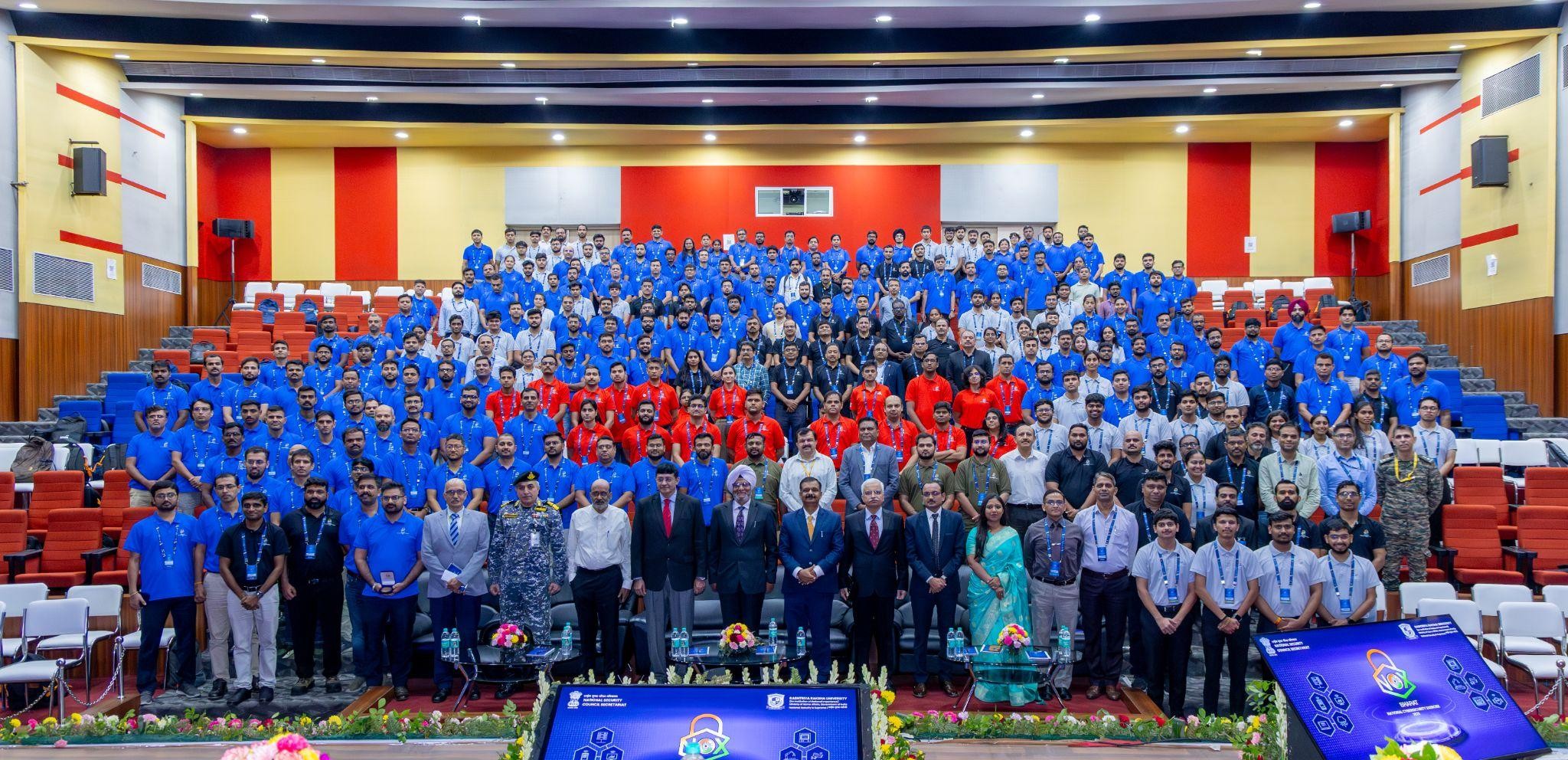
India took a giant leap in digital security this week. The National Cybersecurity Exercise 2025 wrapped up, leaving behind a strong message—India is ready to defend its digital borders.
Jointly organized by the National Security Council Secretariat (NSCS) and Rashtriya Raksha University (RRU), the event brought together over 600 cybersecurity professionals, defense experts, policymakers, and industry leaders.


The five-day exercise was not just another drill. It was a mission. It tackled complex and modern challenges like AI-driven cyber threats, industrial control system (ICS) vulnerabilities, and deepfake attacks.
Experts also trained in advanced modules such as Security Operations Centers (SOC), API security, Reverse Engineering Malware Analysis (REMA), and Digital Forensics and Incident Response (DFIR).
These sessions created a solid foundation for building an agile and future-ready cyber defense system.
Collaboration Meets Innovation
Two parallel events amplified the impact of the exercise: the Bharat CISOs Conclave and the BHARAT Cybersecurity Startup Exhibition.
These platforms enabled real-time idea exchange, showcasing the latest cybersecurity tools, services, and innovations developed by Indian startups. It was a strong push for Aatmanirbhar Bharat in digital defense.
STRATEX: Simulating Real Threats
One of the key highlights of the event was the Strategic Exercise (STRATEX). It tested national readiness through simulated cyberattacks on critical sectors like banking, power grids, and defense systems.
Participants were challenged to coordinate in real time. The goal was clear—improve inter-agency coordination, crisis response, and decision-making under pressure.
This hands-on approach not only improved technical skills but also built trust across agencies.
Leadership Voices Call for Urgent Action
Shri T. V. Ravichandran, Deputy National Security Advisor, delivered a powerful message in his closing address. He emphasized the urgent need to address evolving cyber threat paradigms within the national security framework.
“Digital sovereignty cannot be compromised,” he said. “We need enhanced synergy, unwavering commitment, and continuous innovation to stay ahead.”
His words captured the spirit of the exercise—alert, agile, and united.
Key Learnings from the Front Lines
Major General Manjeet Singh, Joint Secretary (Cyber), NSCS, shared insights gained from the week’s events. He noted a sharp rise in AI-based threats and targeted ICS attacks.
He stressed the importance of continuous capacity building, real-time threat intelligence sharing, and the use of next-gen security technologies.
“We must be faster than the adversaries. That’s the only way forward,” he said.
The Role of Academia in Cybersecurity
Professor Kalpesh Wandra, Pro Vice-Chancellor of RRU, highlighted how educational institutions can drive innovation in cyber defense.
He called for more investment in cybersecurity research, policy analysis, and the development of cross-disciplinary skill sets among students and faculty.
“A strong academic backbone is essential for national resilience,” he said, urging universities to take the lead in shaping India’s cyber future.
Unity, Dedication, and a Vision for the Future
Colonel Debashish Bose, Director at NSCS, concluded the event by thanking all stakeholders. He applauded the collaborative spirit and the tireless efforts of every contributor—from trainers to participants, from technical teams to administrative staff.
“This exercise sets a new benchmark,” he said. “It proves that when India unites for cybersecurity, it rises stronger and more secure.”
Cybersecurity Is National Security
As cyber threats evolve, so must our defenses. The Bharat National Cybersecurity Exercise 2025 served as a wake-up call and a roadmap. It confirmed one truth—cybersecurity is national security.
India’s focus on strategic, technical, and collaborative readiness is no longer optional. It is vital. Through events like this, India sends a clear signal to adversaries—our digital sovereignty is non-negotiable.
The exercise ends, but its lessons live on. Stronger defenses. Smarter strategies. A safer digital India.