
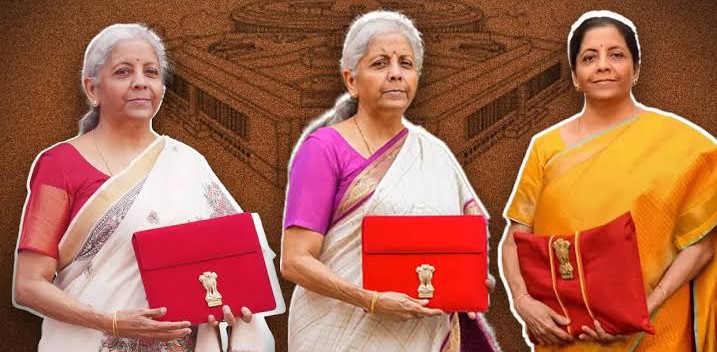
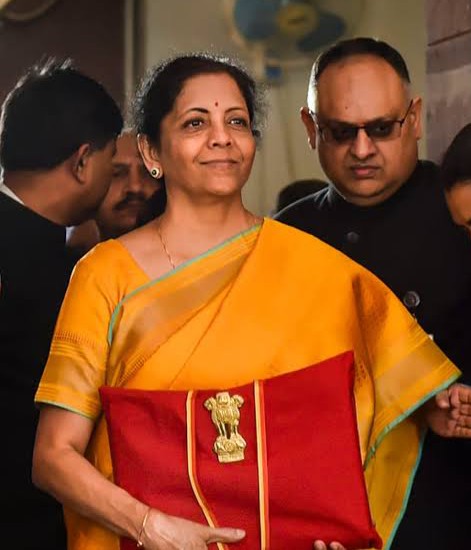

The 2026 Budget will mark Sitharaman’s ninth consecutive Budget presentation an unprecedented milestone for any Indian finance minister. Throughout this period, her wardrobe has consistently highlighted handloom textiles, reinforcing the government’s ‘Vocal for Local’ initiative and its push to strengthen rural livelihoods.
By choosing sarees woven by artisans from Andhra Pradesh, Telangana, Odisha, Bihar, and West Bengal, Sitharaman has brought national attention to crafts that often struggle for mainstream visibility.
2019–2020: New Beginnings and Optimism
In 2019, Sitharaman wore a pink Mangalgiri silk saree with a gold border, symbolising a fresh approach as she presented her first Budget. That year, she also replaced the colonial-era briefcase with a traditional bahi khata, underlining a blend of reform and tradition.
The following year, her yellow saree with blue borders reflected optimism and stability at a time when economic challenges were mounting. Yellow has long been associated with hope and growth, while blue represents calm and resilience.
2021–2022: Resilience Amid Crisis
During the pandemic-hit Budget of 2021–22, Sitharaman opted for a vibrant Pochampally ikat saree from Telangana. The bold colours and intricate patterns mirrored the government’s emphasis on economic recovery and renewal.
In 2022, she chose a rust-brown Bomkai saree from Odisha’s Ganjam district, highlighting indigenous artistry and silver zari work. The choice reinforced the government’s stated commitment to preserving traditional crafts and supporting local artisans.
2023–2025: Confidence and Cultural Assertion
The red silk saree worn in 2023, featuring a black-and-gold temple border, conveyed confidence and strength. Temple motifs such as chariots and lotuses symbolised continuity, power, and tradition during a phase of assertive economic policy.
In 2024, Sitharaman alternated between a blue Tussar silk saree with Kantha embroidery for the interim Budget and an off-white Mangalgiri saree with gold and magenta borders for the full Budget. These choices subtly highlighted eastern and southern states, aligning with regional development initiatives.
Her 2025 saree, featuring Madhubani fish embroidery from Bihar, was gifted by Padma Shri awardee Dulari Devi. The off-white base paired with a red blouse symbolised stability, leadership, and decisive governance.
What Could 2026 Signal?
As Sitharaman steps into her ninth Budget presentation, speculation around her 2026 saree centres on continuity rather than surprise. Observers expect another handloom piece, possibly from a lesser-highlighted region, reinforcing sustainability, inclusivity, and economic balance.
Regardless of interpretation, her attire has undeniably transformed Budget Day into a platform for showcasing India’s textile heritage alongside economic policy.
For artisans and weavers, this silent endorsement carries real economic impact, driving awareness and demand for handloom products across the country.