
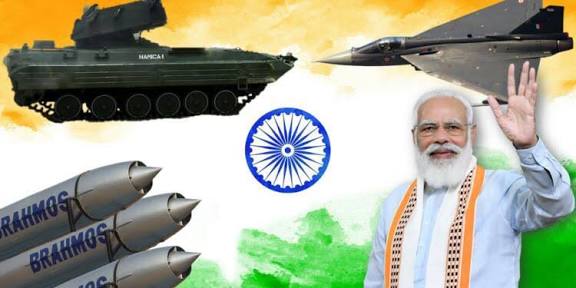
Numbers that mark a turning point
Indigenous defence production reached ₹1,27,434 crore in FY 2023–24 and the overall sector hit ₹1.54 lakh crore in FY 2024–25, reflecting a multi-year push under Aatmanirbhar Bharat. Exports have seen an especially steep climb — from under ₹1,000 crore a decade ago to ₹23,622 crore in FY 2024–25 — signalling improved global acceptance of Indian platforms and components.

About 16,000 MSMEs are now active in defence supply chains, supplying subsystems, components and electronics. While Defence Public Sector Undertakings (DPSUs) still account for a large share of production, private industry’s contribution is rising: the private sector’s share increased to 23% in FY 2024–25, reinforcing an ecosystem that blends public institutions, large private firms and agile small manufacturers.
Policy reforms accelerating change
Key reforms — notably the Defence Acquisition Procedure (DAP) 2020 and the Defence Procurement Manual (DPM) 2025 — have simplified procurement and incentivised indigenous design, development and manufacturing (Buy (Indian-IDDM)). DPM 2025, effective from 1 November 2025, standardises revenue procurement and reduces transactional friction across services and MoD organisations.
Industrial corridors and investment push
Defence industrial corridors in Uttar Pradesh and Tamil Nadu are proving catalytic: combined investments worth over ₹9,145 crore and 289 MoUs point to concentrated manufacturing hubs. Complementary schemes liberalised FDI, PLI incentives and a digital export authorisation portal have expanded investor interest and reduced paperwork for exporters.
Contracts, approvals and capability upgrades
The Ministry recorded a record 193 contracts valued at ₹2,09,050 crore in 2024–25, with 177 contracts worth ₹1,68,922 crore awarded to domestic industry. The Defence Acquisition Council (DAC) continued to clear capital acquisition proposals across services, prioritising indigenous systems such as torpedoes, radars, reconnaissance platforms and electronic warfare suites.
Exports: breadth and diplomacy
India now exports a wide range of products from ammunition, patrol boats and helicopters to radars and lightweight torpedoes to roughly 80–100 countries. Private sector exports accounted for ₹15,233 crore of the 2024–25 total, while DPSUs contributed ₹8,389 crore, reflecting a diversified export basket and growing trust in Indian defence supplies.
Challenges remain
Despite the gains, challenges persist: scaling high-end R&D, securing critical technologies, and ensuring quality across dispersed MSMEs. The government’s Defence Production & Export Promotion Policy (DPEPP) aims to tackle these gaps by promoting R&D, industry-academia linkages, IP creation and stronger support for MSMEs.
What lies ahead
Targets set by the government ₹3 lakh crore in defence production and ₹50,000 crore in exports by 2029 are ambitious but increasingly realistic given the current momentum. Continued reforms, predictable procurement, targeted incentives and deeper private–public collaboration will be essential to transform India into a global defence manufacturing hub.