
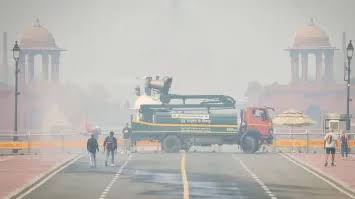
What the order requires
The Environment Department, invoking Section 5 of the Environment (Protection) Act, 1986, has directed that administrative secretaries and department heads attend office regularly while no more than 50% of staff should be physically present at any government office. The remaining staff are to mandatorily work from home. Private establishments operating within the national capital have received similar instructions.
Exemptions apply to essential services such as hospitals, fire services, prisons, public transport, electricity, water and sanitation, disaster management functions and teams actively engaged in air-pollution control and enforcement.
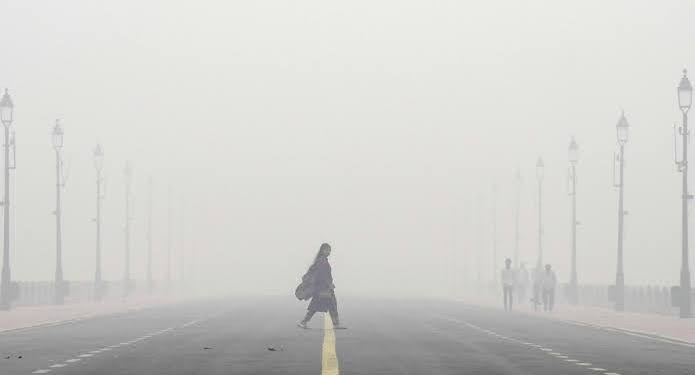

Delhi’s air quality has been in the ‘very poor’ to ‘severe’ range for days. The city recorded a 24-hour average AQI around the high 300s on Monday, and the CPCB’s Sameer app showed that 15 monitoring stations had crossed the 400 mark the threshold for the ‘severe’ category. Authorities have invoked GRAP-related restrictions to curb emissions and reduce outdoor exposure.
Data and modelling show vehicular emissions remain the largest contributor to the capital’s pollution at present; other factors cited include stubble burning in nearby states, ongoing construction dust and stagnant meteorological conditions that trap pollutants. The Indian Institute of Tropical Meteorology’s Decision Support System and CPCB bulletins have both highlighted these drivers.
Where pollution is worst
Several localities logged ‘severe’ AQI readings on the day the order was issued. Locations with readings above 400 included ITO, Punjabi Bagh, Patparganj, Ashok Vihar, Rohini, Vivek Vihar, Narela and Bawana, among others, according to CPCB station reports. Residents in these areas were advised to limit outdoor activity and use masks or air purifiers where possible.
Impact on offices, schools and commuters
Government departments and private firms are required to plan rotas so that not more than half the staff are physically present. Employers are asked to ensure continuity of essential services while allowing a substantial portion of the workforce to work remotely. Transport and infrastructure agencies have been asked to maintain core operations and emergency readiness.
Education authorities in some districts have already adopted hybrid arrangements for younger students and advised parents to keep children indoors where possible until air quality shows sustained improvement.
What residents should do
- Avoid non-essential outdoor activities; wear N95/FFP2 masks when stepping out in high-AQI areas.
- Use indoor air purifiers and keep windows closed during peak smog hours.
- Follow advisory updates from the Central Pollution Control Board and Delhi government.
Government response and enforcement
The Capital’s pollution-control apparatus has increased enforcement of construction-site regulations, checks on industrial emissions and operations to control biomass burning. Officials say more monitoring and targeted action including dust suppression and vehicle emission checks will continue until conditions improve. Residents are urged to report visible violations to civic authorities.
Sources and further reading
For real-time AQI data and station-level readings, consult the Central Pollution Control Board’s Sameer app and AQI bulletin. For official public orders and advisories, see the Delhi government’s environment department notifications.