
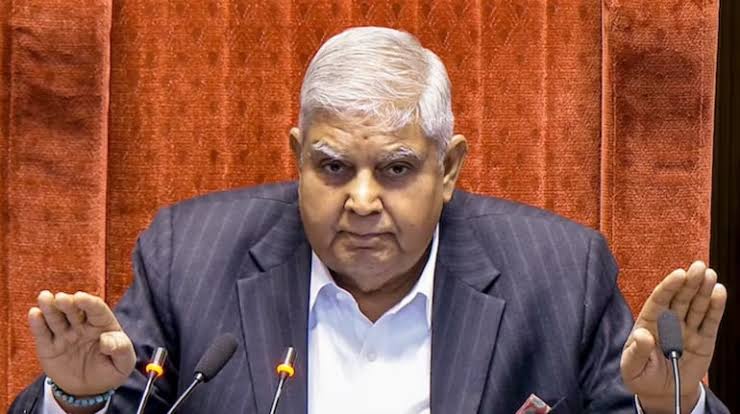
Jagdeep Dhankhar, who took office as the 14th Vice President of India in August 2022, resigned from his post on Monday, ending a controversial tenure defined by his persistent criticism of the Supreme Court. From questioning the Basic Structure doctrine to attacking the 2015 NJAC verdict, his time as Rajya Sabha Chairman was anything but quiet.
Resignation Amid Controversy
Dhankhar’s resignation came unexpectedly late Monday evening. However, his confrontational approach had already shaped his legacy. Throughout his tenure, he often clashed with the judiciary and voiced strong opinions on the boundaries between the legislature and the judiciary.
His tenure began amid conflict. In December 2022, during his very first Rajya Sabha session as Chairman, Dhankhar referred to the Supreme Court’s 2015 judgment that struck down the National Judicial Appointments Commission (NJAC) Act as a “glaring instance” of judicial overreach.


Dhankhar believed the verdict on NJAC weakened Parliament’s authority. He argued that the judiciary had disregarded the “ordainment of the people” by striking down a law passed with near-unanimous support from both Houses. “Parliament must address this issue,” he said in the House on December 7, 2022, echoing statements he had made earlier that week.
He maintained that the judiciary’s use of the Basic Structure doctrine—which prevents Parliament from altering certain fundamental features of the Constitution—was being applied too broadly. According to Dhankhar, this undermined democratic processes and accountability.
Run-ins with Judiciary Continued
The friction didn’t stop there. Earlier this year, in April 2025, Dhankhar reignited controversy after large sums of cash were discovered at the residence of a High Court judge. Speaking publicly, he questioned judicial accountability and called for systemic reform.
These comments stirred debate across legal and political circles. Many saw his remarks as part of a larger effort to restore parliamentary primacy. Others felt they risked undermining the independence of the judiciary.
Legacy of Conflict from Bengal to Delhi
Before becoming Vice President, Dhankhar had served as Governor of West Bengal, where he frequently clashed with the Trinamool Congress (TMC) government. His criticism of state policies, handling of law and order, and direct confrontations with the Chief Minister kept him in headlines.
In Delhi, that confrontational tone continued. Dhankhar positioned himself as a custodian of constitutional morality and legislative supremacy. He believed the balance of power was tilting too far in favour of the judiciary and called for a course correction.
What Happens After a Vice-President Resigns?
According to the Constitution, if the Vice President resigns mid-term, the office falls vacant and must be filled within six months. The President can appoint an interim Chairman for Rajya Sabha. The Election Commission will likely initiate the process for electing a new Vice President shortly.
Final Thoughts on Dhankhar’s Tenure
Jagdeep Dhankhar’s time as Vice President was far from ceremonial. He brought fierce debate to the center of India’s constitutional discourse. His emphasis on restoring the sovereignty of Parliament will be remembered as both bold and divisive.
As India awaits his successor, questions remain: Will the next Vice President maintain continuity or chart a more conciliatory course? For now, Dhankhar’s term has left a lasting imprint on the complex relationship between the three pillars of Indian democracy.