
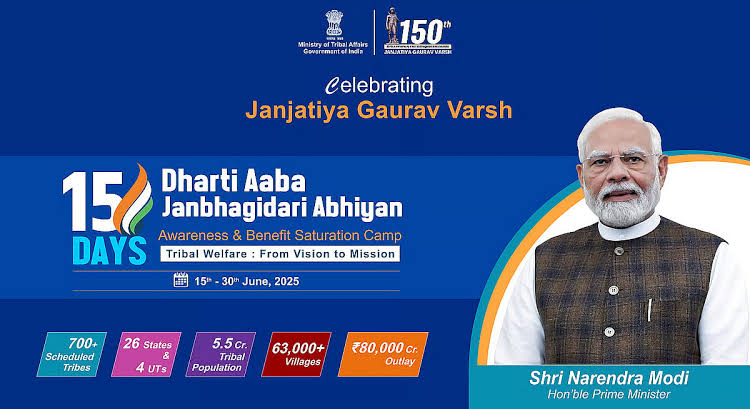
Focus on Chandauli’s Tribal Villages
In Uttar Pradesh, 17 tribal villages from Chandauli district’s Naugarh and Chahniya development blocks have been identified under DAJGUA. These villages were selected based on tribal population thresholds and their inclusion in aspirational blocks. The programme’s coverage in Chandauli has gained significance following the 2022 amendment to the Constitution (Scheduled Tribes) Order, which formally included the district within Uttar Pradesh’s Scheduled Tribe framework.
The identified villages together account for a population of over 36,000, with more than 2,100 Scheduled Tribe residents. Beneficiaries are being systematically linked with welfare schemes spanning housing, water supply, education, health, livelihoods, digital connectivity and social security.
Water, Housing and Road Connectivity
Under the Jal Jeevan Mission, focused interventions have enabled near-universal access to Functional Household Tap Connections in DAJGUA villages. Fifteen out of the 17 identified villages in Chandauli have already achieved 100 percent household tap water coverage, significantly improving access to safe drinking water in tribal habitations.
Housing support under Pradhan Mantri Awaas Yojana–Gramin has also yielded tangible results. Since 2015, 176 pucca houses have been sanctioned and completed for Scheduled Tribe families across Chandauli’s blocks, ensuring dignified living conditions with basic amenities.
Road infrastructure has seen complete saturation under the Pradhan Mantri Gram Sadak Yojana. A total of 277 road projects covering over 1,030 kilometres have been completed in the district, enhancing access to markets, schools and healthcare facilities in remote tribal areas.
Livelihoods, Employment and Skill Development
Livelihood generation remains a central pillar of the Abhiyan. Through convergence with MGNREGA, tribal households in Chandauli are receiving wage employment and income security via works related to water conservation, land development and rural connectivity. Hundreds of households have been provided employment annually, with steady personday generation over recent financial years.
In parallel, skill development initiatives under Skill India, including PMKVY and PM Vishwakarma, have trained and certified thousands of Scheduled Tribe youth nationwide. These programmes aim to enhance employability and promote traditional crafts, self-employment and entrepreneurship among tribal communities.
Van Dhan, Forest Rights and Cultural Preservation
The Ministry of Tribal Affairs, through agencies such as TRIFED and NSTFDC, continues to promote value addition and enterprise development via Van Dhan Vikas Kendras. While proposals from Chandauli are awaited, Uttar Pradesh has already received approvals for multiple VDVKs under PMJVM and PM JANMAN schemes.
Implementation of the Forest Rights Act has also progressed, with individual and community titles distributed in Chandauli, strengthening land security for forest-dwelling tribals. Post-claim support under DAJGUA aims to improve agricultural productivity and livelihoods for FRA beneficiaries.
Cultural preservation is being supported through Tribal Research Institutes, including TRI Lucknow, which documents tribal heritage, organises festivals and promotes awareness of indigenous traditions, languages and customs.