
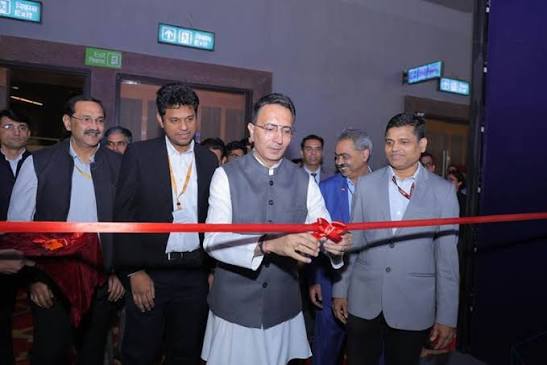
Located in Hall 6, the pavilion is among the most visited attractions of IITF this year. It demonstrates how India’s digital public infrastructure is making services more transparent, inclusive, and citizen-friendly—echoing the fair’s theme, “Ek Bharat, Shreshtha Bharat.”
UMANG, DigiLocker and myScheme Lead Citizen-Centric Services
A major highlight of the pavilion is the suite of e-governance platforms that millions of Indians use daily. The UMANG app, which integrates services from over 210 government departments, is displayed with live demonstrations. Currently available in 23 languages, UMANG hosts more than 2,100 services and has over 9.63 crore registered users.
DigiLocker, one of India’s most impactful digital tools, is presented with an immersive walkthrough of its paperless, secure documentation system. With more than 60 crore users and thousands of issuer and requester organizations, it remains central to India’s digital governance framework.
The myScheme platform, a unified portal that helps citizens discover government schemes based on eligibility, is also showcased prominently. Visitors can explore more than 4,000 central and state schemes through an AI-powered interface, along with QR-based onboarding for real-time engagement.
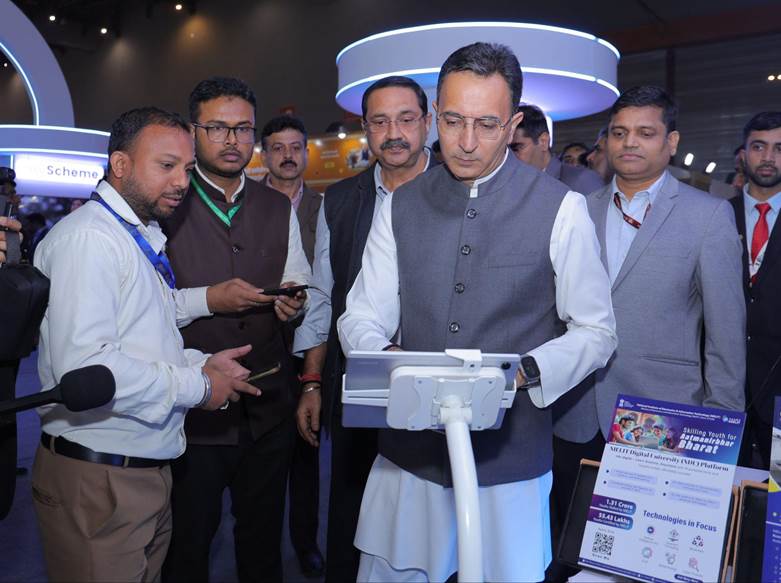

The Aadhaar exhibit introduces the newly redesigned Aadhaar app, built for enhanced security and simple user navigation. Features include selective data sharing, advanced face verification, and offline verification through QR codes. Demonstrations at the pavilion help visitors understand these upgrades and their practical uses.
Strengthening India’s digital learning ecosystem, NIELIT showcases its Digital University Platform, virtual labs, smart learning pathways, and AI-enabled tools such as NIELIT Mitra. The platform offers flexible learning across 20+ domains, helping students and professionals embrace future-ready digital skills.
NIXI, CERT-In and India Semiconductor Mission Display Emerging Tech Strength
The National Internet Exchange of India (NIXI) presents India’s growing digital identity ecosystem through an array of third-level domain offerings. These include tech-centric domains like .ai.in and .io.in, professional identity domains such as .dr.in and .er.in, as well as lifestyle-focused domains like .travel.in.
CERT-In, India’s cybersecurity nodal agency, highlights new initiatives that aim to strengthen national cyber resilience. The exhibits focus on secure digital practices, enterprise cyber-readiness, and citizen awareness programmes.
At the India Semiconductor Mission (ISM) section, visitors can explore India’s expanding chip-design ecosystem. Under the Design Linked Incentive Scheme, ISM has already supported 24 chip design projects, 87 start-ups, and over 290 academic institutions. Details of ongoing fab, ATMP, and compound semiconductor projects underline India’s growing ambition in the global semiconductor supply chain.
IndiaAI Pavilion Highlights Responsible and Inclusive AI Future
A dedicated IndiaAI Pavilion captures India’s vision for an inclusive and sustainable AI future. It also serves as a preview to the India-AI Impact Summit 2026 by showcasing its three core principles—People, Planet, and Progress. Exhibits feature global impact challenges like “AI for All,” “AI by HER,” and the youth-oriented “YUVAi” programme.
Interactive stations also spotlight IndiaAI’s innovation programs, research initiatives, AI expo plans, and talent-building efforts such as the IndiaAI Tinker preneur platform.
A Unified Showcase of India’s Digital Transformation
The Digital India Pavilion brings together a diverse ecosystem of government-led technological reforms, reflecting India’s evolving digital identity. From everyday citizen services to advanced technologies like AI and semiconductor development, the pavilion demonstrates how digital infrastructure is reshaping governance, education, and industry.
Over the two-week fair, lakhs of visitors are expected to engage with these interactive exhibits, gaining firsthand experience of India’s expanding digital footprint. The pavilion stands as a strong example of the government’s commitment to building a digitally empowered society and a knowledge-driven economy.