
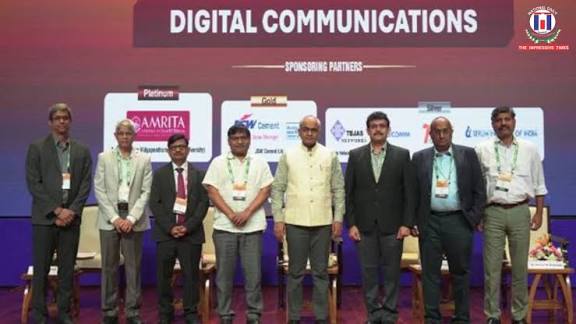
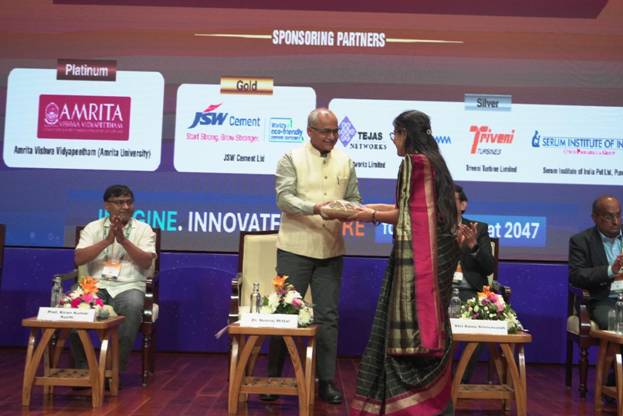

The Secretary also showcased the Bharat 6G Alliance, which has formed 10 global collaborations and aims for India to contribute 10% of worldwide 6G patents by 2030. “Connectivity is the bedrock of productive activity, and India’s telecom revolution directly fuels national economic growth,” Dr. Mittal added.
Keynote speaker Prof. Kiran Kumar Kuchi, IIT Hyderabad, outlined the roadmap for achieving the 6G vision. Industry leaders Shri Ramu Srinivasaiah of Lekha Wireless Solutions and Dr. Kumar N. Sivarajan of Tejas Networks highlighted advancements in private networks and strategies to make India a global telecom leader by 2030.
A panel moderated by Dr. Rajkumar Upadhyay, CEO of C-DOT, included experts from IIT Madras, IISc Bengaluru, BSNL, and Tejas Networks. Discussions focused on extending India’s 5G ecosystem, leveraging indigenous navigation technology through NavIC L1, and building disruptive technology stacks from Device-to-Machine (D2M) communication to 6G.
ESTIC 2025, inaugurated by Prime Minister Narendra Modi, attracted over 3,000 participants including Nobel laureates, scientists, innovators, and policymakers. The event covered 11 critical technology areas, including Advanced Materials, AI, Bio-Manufacturing, Blue Economy, Digital Communications, Semiconductor Manufacturing, Emerging Agriculture Technologies, Energy, Environment & Climate, Health & Medical Technologies, Quantum Science, and Space Technologies.