

The SUJVIKA portal, developed in collaboration with industry body ABLE, serves as a Trade Statistics Digital Intelligence Platform. It provides structured and authenticated data on biotechnology product imports, including biochemical products and industrial enzymes.
The platform enables startups, researchers and industry stakeholders to identify high-value and high-volume imports, assess dependency, and prioritise indigenous R&D efforts. By facilitating evidence-based planning, SUJVIKA aims to strengthen domestic biomanufacturing and promote public–private partnerships.
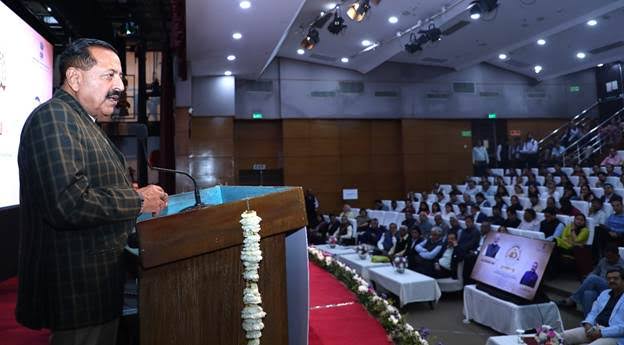
Speaking at the event held at the Civil Services Officers Institute (CSOI) in New Delhi, Dr Jitendra Singh said India has positioned biotechnology as a key driver of economic growth under the vision of Viksit Bharat.
Bioeconomy Expands 16-Fold
Highlighting DBT’s four-decade journey since its establishment in 1986, the Minister noted that India’s bioeconomy has grown nearly 16-fold in a decade—from around $10 billion in 2014 to $165.7 billion in 2024. He said the country is now among the top global biotech destinations and a leading vaccine manufacturer.
From fewer than 100 biotech startups in 2014, India today has more than 11,000, reflecting a rapidly expanding innovation ecosystem. The Minister credited policy reforms and institutional support for this transformation.
BioE3 Policy and ₹2,000 Crore RDI Push
Dr Jitendra Singh referred to the recently approved BioE3 Policy Biotechnology for Economy, Environment and Employment which aims to foster high-performance biomanufacturing nationwide. The policy is being implemented by DBT, BIRAC and the Biotechnology Research and Innovation Council (BRIC).
He also announced that the first national call under the ₹1 lakh crore Research, Development and Innovation (RDI) initiative has been launched, with ₹2,000 crore earmarked to boost enterprises ready for large-scale growth.
The Minister said the integration of artificial intelligence with biotechnology will reduce research timelines and improve precision in gene sequencing, diagnostics and drug discovery.
Building Infrastructure for Scale
India has established a National Biofoundry Network comprising six specialised biofoundries and 21 advanced bio-enabler facilities to accelerate scale-up and commercialisation. Additionally, 95 bio-incubators across 21 States and UTs are supporting more than 1,800 incubatees.
Four regional mentoring centres and technology transfer offices are further strengthening the translation of laboratory research into market-ready products.
GenomeIndia and Gene Therapy Milestones
Dr Jitendra Singh highlighted achievements such as the GenomeIndia Project, which has sequenced the genomes of 10,000 individuals across 99 diverse populations. The data, hosted at the Indian Biological Data Centre, will support personalised medicine and advanced genomic research.
He also cited India’s first human gene therapy trial for Severe Hemophilia A, supported by DBT and BIRAC, which demonstrated sustained Factor VIII production and reduced dependence on repeated infusions.
New Frontiers: Space Biotechnology
The Minister noted India’s entry into space biotechnology and space medicine through collaboration between DBT and ISRO. Experiments conducted during space missions in life sciences and muscle physiology signal India’s expanding scientific ambitions.
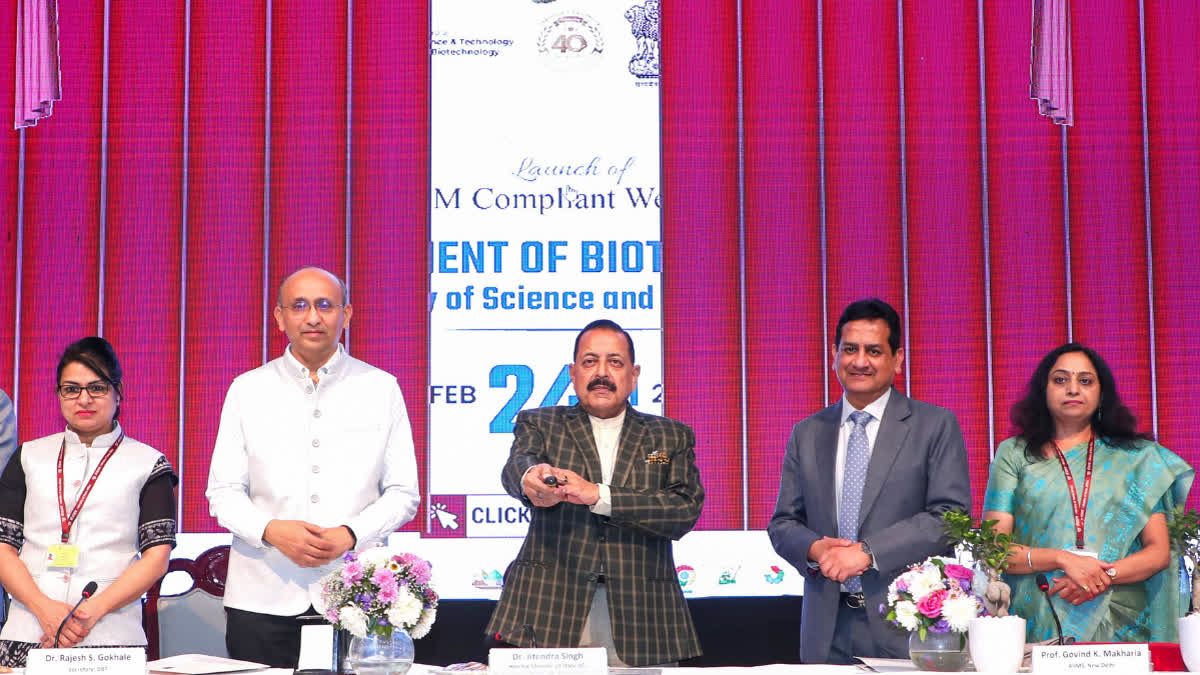
On the occasion, Dr Jitendra Singh also launched DBT’s revamped website aligned with the Government of India’s Digital Brand Identity Manual (DBIM) framework.
Secretary DBT Dr Rajesh S. Gokhale described the Department’s evolution from capacity-building to entrepreneurship-driven innovation, emphasising genome editing and high-performance biomanufacturing as emerging pillars.
Concluding the event, Dr Jitendra Singh expressed confidence that DBT and its partner institutions will drive India’s bio revolution from laboratories to large-scale industry, cementing biotechnology’s central role in the nation’s growth story.