 Five Joint Projects Under AISRF Round-16
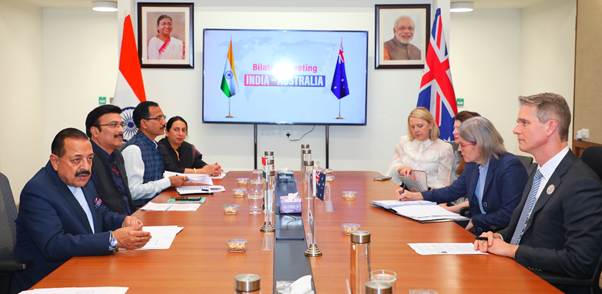
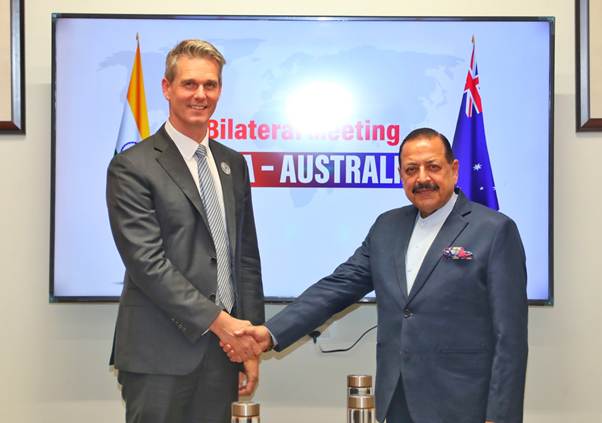
The two Ministers reviewed the Australia–India Strategic Research Fund (AISRF), which marks 20 years in 2026, and announced the finalisation of five joint research projects under Round-16. The initiatives focus on critical minerals, quantum technologies, advanced manufacturing, climate-resilient agriculture, and cellular immunotherapy.
India’s Department of Science and Technology (DST) will support three projects targeting high-value electronic waste recycling through photovoltaic panel reuse, green chemistry for recovering critical minerals from batteries, and enhancing adversarial resilience in quantum machine learning systems. Meanwhile, the Department of Biotechnology (DBT) will back research in thermotolerant crops and cellular immunotherapy for immunocompromised patients.
Mission-Mode Research and Industry Integration
Dr. Jitendra Singh emphasised India’s focus on frontier areas such as advanced materials, quantum technologies, AI-driven research, clean energy, and critical minerals. He highlighted the BioE3 policy as a strategic initiative to position India as a global bio-economy hub, stressing the importance of industry participation to ensure research translates into scalable solutions.
Strengthening Bilateral S&T Mechanisms
The Ministers reaffirmed the role of the India–Australia Joint S&T Committee and the Joint Biotechnology Committee in guiding bilateral cooperation. They agreed that future projects should be larger, impact-oriented, and multi-institutional, aligned with shared national priorities and the United Nations Sustainable Development Goals.
Since its inception in 2006, AISRF has supported over 370 joint initiatives, including research projects, fellowships, and workshops. Australia contributed AUD 90 million between 2006 and 2020, with continued funding announced for subsequent rounds, while India’s DST and DBT have invested around ₹140 crore. Joint publications have more than tripled, generating patents, technology demonstrators, and extensive researcher mobility.
Expanding Collaboration in Space and Research Mobility
The Ministers also discussed potential cooperation in space technology, covering Earth observation for agriculture, disaster management, maritime applications, space situational awareness, and long-term sustainability of outer space. Both countries agreed to deepen researcher mobility through joint doctoral and postdoctoral programs, industry-linked fellowships, and co-supervision models.
The meeting highlighted the growing strategic importance of science, technology, and innovation in India–Australia relations, with both nations aiming to transition from conventional collaboration to co-development, co-creation, and industry-integrated innovation within the Indo-Pacific framework.