
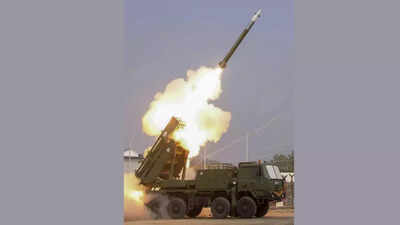


According to official information released by the Press Information Bureau (PIB), the Pinaka LRGR was tested for its full operational range of 120 km. Throughout the flight, the rocket executed all planned in-flight manoeuvres and impacted the designated target with what officials described as “textbook precision.”
Advanced tracking instruments deployed along the range corridor monitored the rocket’s trajectory from launch to impact, validating its guidance, control, and navigation systems. The flawless performance during the maiden test is seen as a major confidence booster for the programme.
Indigenous Design and Collaborative Development
The Pinaka Long Range Guided Rocket has been indigenously designed by the Armament Research and Development Establishment (ARDE), Pune. The project involved close collaboration with the High Energy Materials Research Laboratory (HEMRL), while technical and integration support was provided by the Defence Research and Development Laboratory (DRDL) and Research Centre Imarat (RCI).
The flight trial was jointly coordinated by the Integrated Test Range, Chandipur, and the Proof and Experimental Establishment (PXE). This collaborative effort reflects DRDO’s integrated approach to developing complex weapon systems entirely within the country.
Versatility of the Pinaka Weapon System
A key highlight of the trial was the launch of the LRGR from an in-service Pinaka multi-barrel rocket launcher. This demonstrates the system’s versatility and confirms that different variants of the Pinaka rocket family, with varying ranges, can be fired from the same launcher platform.
The Pinaka system, already in service with the Indian Army, is a critical component of India’s artillery modernisation programme. The addition of long-range guided rockets significantly enhances its ability to deliver precise and deep strikes, reducing dependence on conventional unguided munitions.
Boost to Armed Forces’ Firepower
Raksha Mantri Shri Rajnath Singh congratulated DRDO and the associated teams for the successful test. He noted that the development of long-range guided rockets would significantly boost the operational capabilities of the Armed Forces and described the achievement as a potential “game changer” in modern warfare.
Precision-guided artillery rockets like the Pinaka LRGR enable forces to neutralise high-value targets at extended ranges while minimising collateral damage, a crucial requirement in contemporary conflict scenarios.
DRDO Leadership Applauds the Achievement
Secretary, Department of Defence R&D and Chairman, DRDO, Dr Samir V Kamat, witnessed the flight trial and congratulated all the scientists, engineers, and technical staff involved in the project. He praised the teams for meeting all mission objectives during the maiden test.
The successful trial is expected to pave the way for further user trials and eventual induction of the Pinaka Long Range Guided Rocket into the Indian Army, strengthening India’s indigenous artillery strike capability.
Strategic Significance
The successful test of the Pinaka LRGR aligns with the government’s ‘Aatmanirbhar Bharat’ vision in defence manufacturing. By developing advanced guided rocket systems domestically, India reduces its reliance on imports and enhances strategic autonomy.