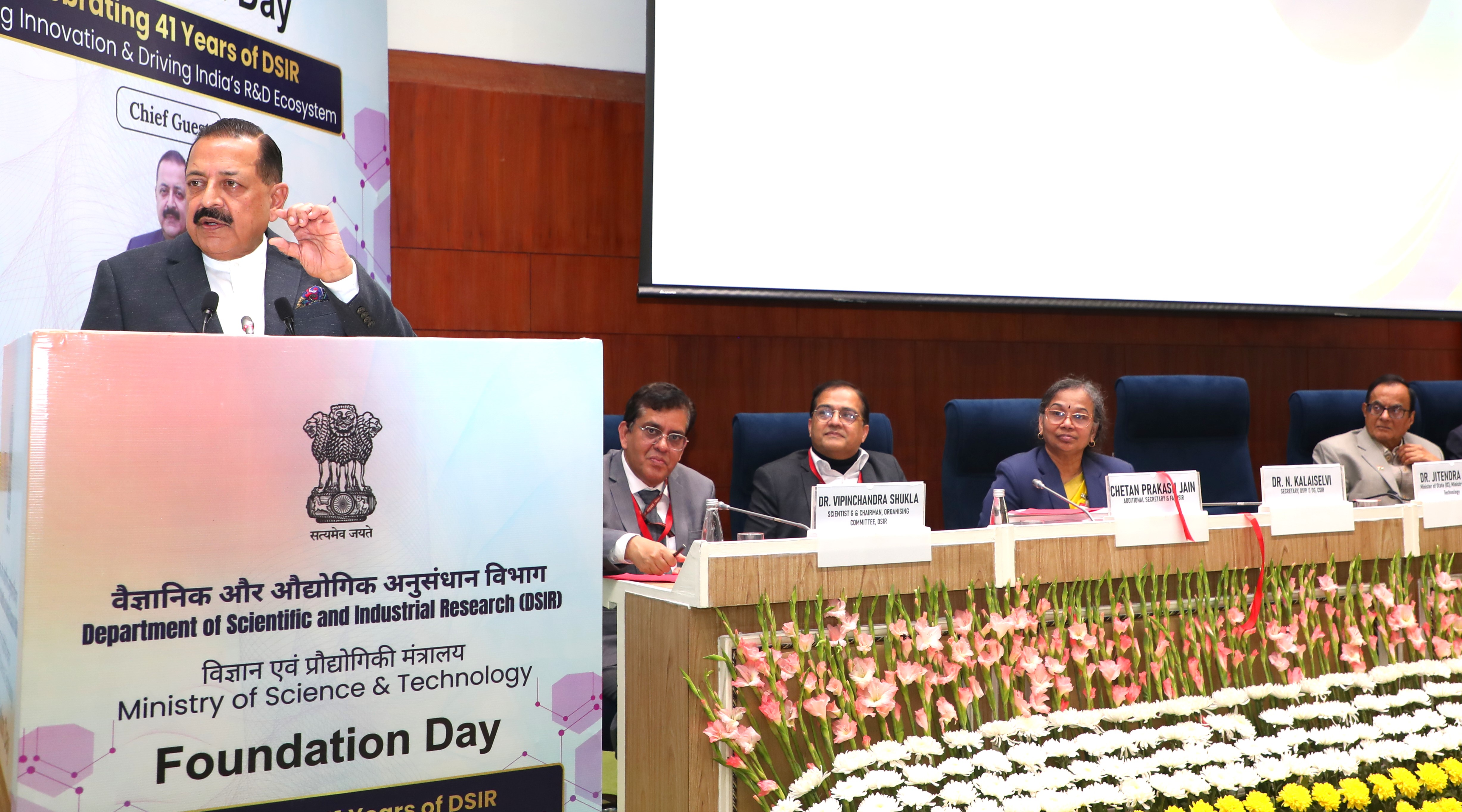
 Major Relief for Early-Stage Deep-Tech Startups
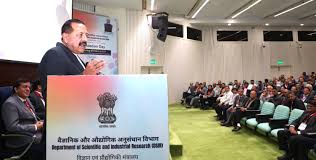
Addressing scientists, policymakers and industry leaders, Dr. Jitendra Singh described the move as a “huge relief” for early starters and first-generation entrepreneurs in the deep-tech sector. He said the earlier requirement of proving three years of operational sustainability often delayed recognition and access to institutional support for promising startups.
With the relaxation now in place, startups working on advanced technologies will be able to seek DSIR recognition based on technological maturity rather than age. The Minister underlined that evaluation standards linked to innovation quality and technical readiness will continue to remain robust.
Strengthening India’s R&D and Innovation Framework
Dr. Jitendra Singh linked the reform to the broader push for research and innovation, including the ₹1 lakh crore Research, Development and Innovation (RDI) Fund announced by the government. While the RDI Fund primarily supports startups that have achieved a certain level of technological readiness, he said several other schemes across departments such as DST, CSIR and TDB cater to early-stage innovators.
The removal of the three-year eligibility condition, he noted, reflects the government’s growing confidence in India’s innovators and its willingness to trust young enterprises with public support at an earlier stage.
DSIR and CSIR: An Intergenerational Partnership
The Minister highlighted the close working relationship between DSIR and the Council of Scientific and Industrial Research (CSIR), describing it as an “intergenerational symbiosis.” He said DSIR, which emerged from CSIR, continues to enable technology transfers, industry partnerships and research-commercialisation efforts across India.
This coordination, he added, has transformed interdisciplinary science into long-term collaboration between government, academia and industry an essential ingredient for a resilient innovation ecosystem.
From Atmanirbhar to Global Reliance
Dr. Jitendra Singh observed that India has moved beyond the goal of Atmanirbhar Bharat and is now entering a phase where global economies increasingly rely on Indian technology. Citing examples from vaccines, medical devices and indigenous technologies, he said India has transitioned from import dependence to large-scale exports.
“We are not only self-reliant; we are making others rely on us,” the Minister remarked, highlighting India’s growing credibility in science, technology and innovation.
Women’s Participation and New Initiatives
The Minister also highlighted the strong participation of women in DSIR-supported programmes. Currently, more than 10,000 women beneficiaries and over 55 women-led self-help groups are availing support under DSIR schemes, reflecting a positive and irreversible shift in India’s innovation culture.
On the occasion, four major initiatives were launched, including revised DSIR guidelines for deep-tech startup recognition, the PRISM Network Platform–TOCIC Innovator Pulse, Creative India 2025 under the PRISM scheme, and the DSIR Disaster Management Plan.
MoUs and Technology Transfers
Several agreements and MoUs were exchanged to strengthen technology-led development. These included an agreement under the Technology Development and Utilisation Programme for Women to establish a Skill Satellite Centre in Dhamtari, Chhattisgarh, in collaboration with NIT Raipur.
Transfer of Technology agreements under the Common Research and Technology Development Hubs programme were also signed, reinforcing MSME-focused R&D and industry partnerships.