
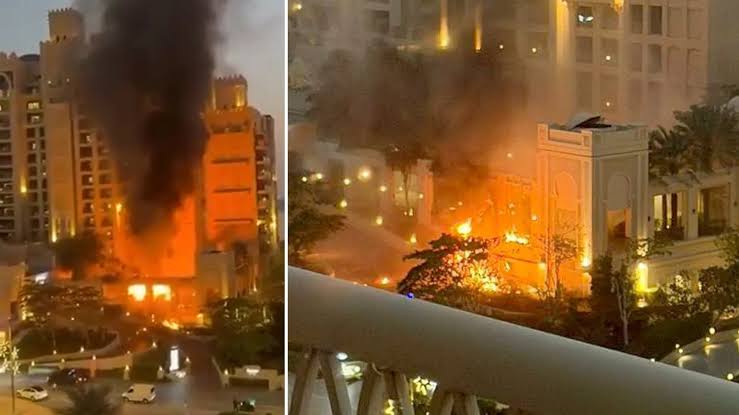

According to Dubai’s media office, a concourse at Dubai International Airport (DXB) sustained minor damage during the overnight incident. Officials stated that the situation was quickly brought under control. Four people were reported injured at the airport, though their condition was not disclosed.
Aviation sources indicated that one of the airport terminals was affected during the retaliatory strikes. Dubai International Airport is among the world’s busiest transit hubs, connecting East and West through thousands of weekly flights. Even limited disruption can have cascading global effects.
Burj Al Arab Hit by Debris
The sail-shaped Burj Al Arab, one of Dubai’s most recognisable symbols, also suffered minor damage. Authorities confirmed that a drone was intercepted, and falling debris sparked a small fire on the hotel’s outer façade. Emergency services quickly extinguished the blaze.
Opened in 1999 on an artificial island off Jumeirah Beach, the Burj Al Arab represents Dubai’s ambition to position itself as a global luxury tourism destination. While officials described the damage as minor, visuals circulating on social media showed smoke rising from parts of the structure.
Fire at Jebel Ali Port
In a separate development, one of the berths at Jebel Ali Port caught fire after debris from aerial interceptions fell into the area. Authorities confirmed the fire was contained without major structural damage to port operations.
Jebel Ali Port plays a critical role in regional trade and supply chains, serving as a major maritime gateway for the Middle East.
Regional Escalation and Wider Impact
The attacks were part of broader Iranian retaliatory action that reportedly targeted locations across the Gulf, including Abu Dhabi and Doha. In the UAE capital, an incident at Zayed International Airport resulted in one reported fatality and several injuries, though details remain limited.
Airlines responded swiftly by suspending flights to and from major Gulf airports, including Dubai and Abu Dhabi. Flight-tracking data showed unusually empty skies over large parts of the Middle East as carriers rerouted or cancelled services for safety reasons.
Industry analysts warn that prolonged instability could impact global aviation networks and energy markets, given the Gulf’s strategic position in both sectors.
Strategic and Economic Significance
Dubai is the Middle East’s largest tourism and trade hub. Its airport handles tens of millions of passengers annually, while its ports anchor international shipping routes. Any disruption to these facilities reverberates far beyond the region.
The Burj Al Arab is more than a hotel; it is a global branding symbol for the emirate’s economic success. Damage to such landmarks underscores the widening geographical scope of the conflict.
For Indian travellers and businesses, the Gulf region remains vital. The Ministry of External Affairs regularly updates travel advisories, which can be accessed through the official Government of India portal at https://www.mea.gov.in. Aviation updates are also issued by India’s Directorate General of Civil Aviation at https://www.dgca.gov.in.
Security Tightened Across UAE
Authorities across the United Arab Emirates have heightened security measures following the strikes. Emergency services remain on alert, and aviation authorities are coordinating with international airlines to restore normal flight operations.
Officials emphasised that damage at key facilities was limited and that operations would resume in phases after safety inspections.
As geopolitical tensions continue to evolve, the situation remains fluid. Global markets and diplomatic channels are closely monitoring developments in the Gulf region.