

The agreement provides for the formation of the Frontier Nagaland Territorial Authority for six eastern districts of the state Tuensang, Mon, Kiphire, Longleng, Noklak and Shamator. Under the new arrangement, powers related to
46 identified subjects will be devolved to the FNTA, enabling greater administrative autonomy and faster decision-making for regional development.
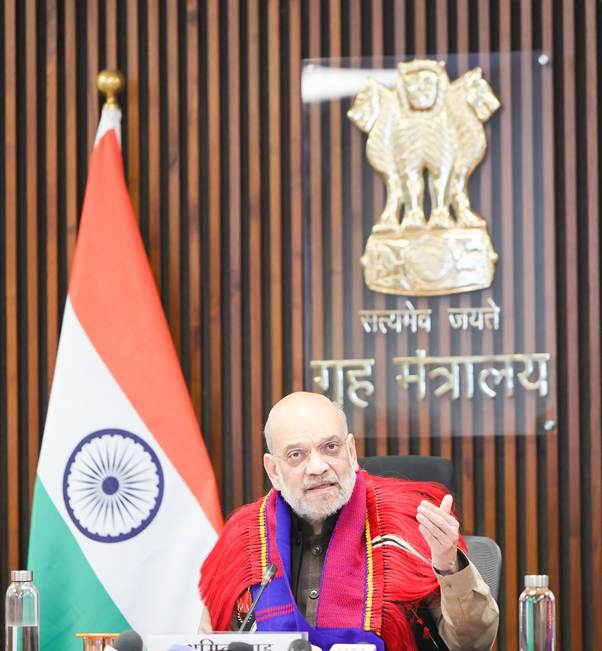
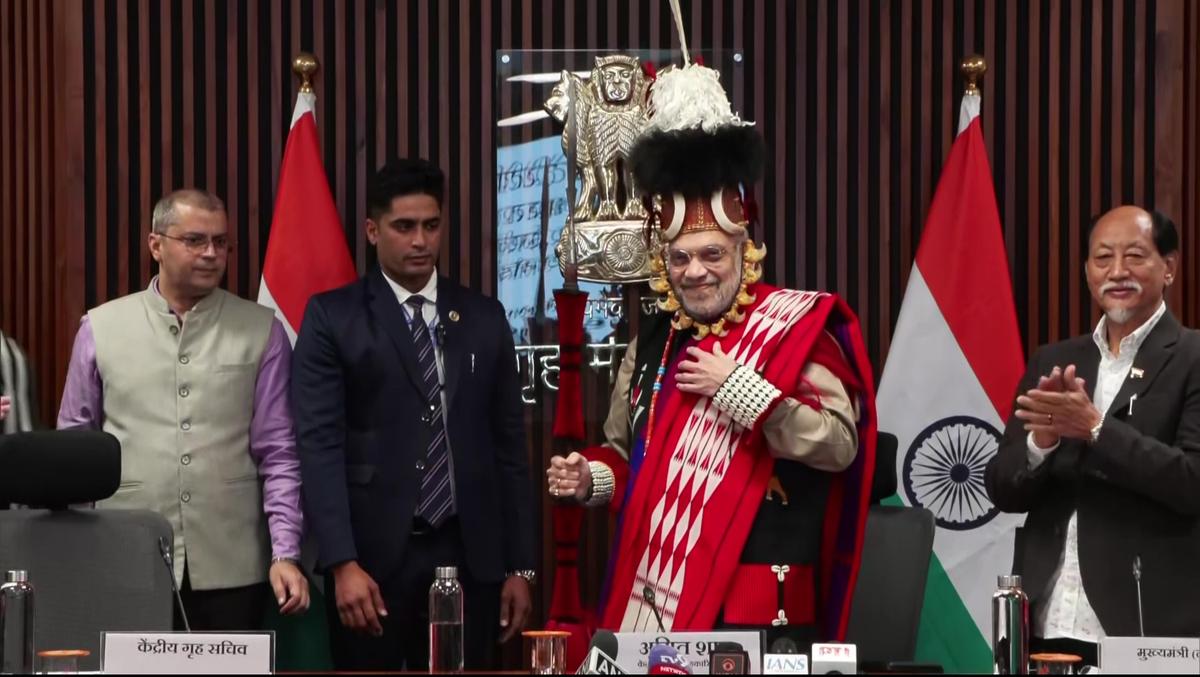
The pact was signed in the presence of Union Home Minister and Minister of Cooperation Amit Shah and Nagaland Chief Minister Neiphiu Rio, underscoring the political commitment at both the Centre and the state level to resolve complex regional issues through dialogue and consensus.
Centre Assures Financial Support and Institutional Framework
Addressing the gathering, Home Minister Amit Shah said the agreement represents another decisive step toward a dispute-free Northeast. He noted that since 2019, the Modi government has signed 12 significant peace and settlement agreements in the region, emphasising that unlike earlier regimes, the current government ensures
implementation in both letter and spirit.
Shah assured ENPO representatives that the Union Government would shoulder its responsibility in developing Eastern Nagaland. A fixed annual financial allocation will be decided, while the Union Ministry of Home Affairs will bear the initial expenditure for establishing FNTA institutions, including a mini-secretariat headed by an Additional Chief Secretary or Principal Secretary.
Addressing Long-Standing Grievances of Eastern Nagaland
The Home Minister acknowledged that since the formation of Nagaland, people in its eastern districts have felt a persistent sense of neglect and injustice. He recalled assurances given to ENPO leaders in 2021–22 that their demands would be addressed through democratic means, urging them to maintain faith in dialogue and institutions.
Shah credited sustained efforts by officials of the Ministry of Home Affairs for acting as a bridge between ENPO and the Nagaland government, ultimately bringing negotiations to a successful conclusion.
Role of Nagaland Government Praised
Expressing gratitude to Chief Minister Neiphiu Rio, the Union Home Minister said the Nagaland government, its cabinet colleagues and Members of Parliament displayed magnanimity and openness during negotiations. Their willingness to engage constructively helped ensure that ENPO’s concerns were addressed without undermining the constitutional framework of the state.
Importantly, the agreement explicitly states that it does not affect the provisions of Article 371(A)
of the Constitution, which safeguards Nagaland’s special status and customary laws.
Accelerated Development and Democratic Resolution
The FNTA arrangement envisages accelerated infrastructure development, economic empowerment and optimal resource utilisation through enhanced financial autonomy and decentralised governance. With administrative obstacles removed, leaders believe Eastern Nagaland can now pursue balanced growth aligned with local needs.
The agreement also reinforces the principle that enduring solutions to regional disputes can only be achieved through dialogue, mutual respect and democratic negotiation, rather than conflict or violence.