
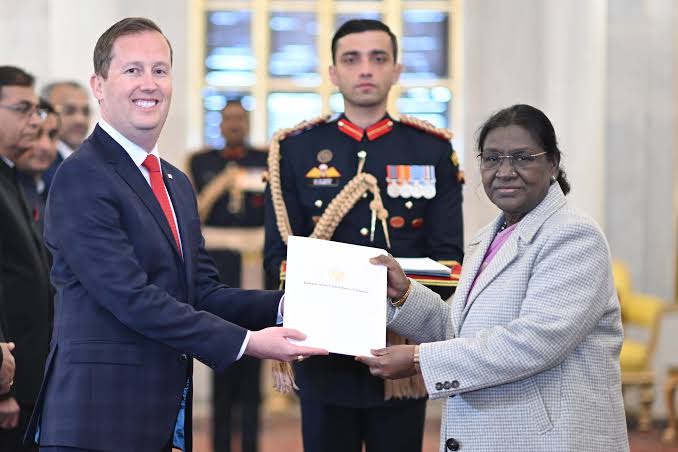
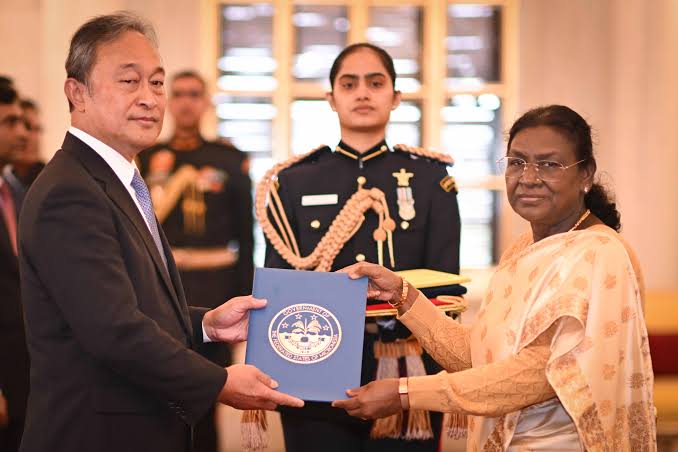

The credentials ceremony took place in the stately environs of Rashtrapati Bhavan, the official residence of the President of India. Known for its ceremonial significance, the venue reflects the dignity and continuity of India’s diplomatic traditions. The event followed established protocol, with each envoy individually meeting the President and presenting their credentials.
Such ceremonies not only signify diplomatic formality but also offer an opportunity to reaffirm India’s commitment to constructive engagement with nations across regions, cultures, and political systems.
Envoys Who Presented Their Credentials
The first envoy to present credentials was H.E. Mr Chandradath Singh, High Commissioner of the Republic of Trinidad and Tobago. His appointment is expected to further enhance cooperation between India and the Caribbean nation, particularly in areas such as trade, culture, education, and people-to-people exchanges.
India and Trinidad and Tobago share historical and cultural ties, rooted in the Indian diaspora that has played a significant role in shaping the Caribbean country’s social fabric. Diplomatic engagement at this level is seen as a step towards deepening those longstanding bonds.
The second envoy, H.E. Dr Robert Zischg, Ambassador of the Republic of Austria, also presented his credentials to the President. India and Austria enjoy cordial relations, with cooperation spanning renewable energy, innovation, higher education, and sustainable development.
Austria has been a supportive partner in strengthening India’s engagement with Europe, particularly in the fields of technology, environmental protection, and cultural exchange.
The third envoy to present credentials was H.E. Mr Sergio Gor, Ambassador of the United States of America. India–US relations have grown into a comprehensive global strategic partnership over the past two decades, encompassing defence, trade, clean energy, critical technologies, and people-to-people ties.
The presentation of credentials by the US Ambassador comes at a time when bilateral engagement continues to expand across regional and global platforms.
Importance of the Credentials Ceremony
The acceptance of credentials by the President is more than a ceremonial formality. It represents the readiness of India to engage diplomatically with the concerned nations and work collaboratively on shared priorities. These ceremonies also reaffirm India’s respect for international diplomatic norms and mutual sovereignty.
As the constitutional head of the state, the President plays a central role in formal diplomatic processes, while day-to-day foreign policy is guided by the Ministry of External Affairs and the elected government.
India’s Expanding Diplomatic Footprint
India’s engagement with countries across continents reflects its growing role in global affairs. From the Caribbean and Europe to North America, New Delhi continues to strengthen bilateral and multilateral partnerships aligned with its national interests and global responsibilities.
The presence of envoys from diverse regions presenting credentials on the same day highlights India’s wide-ranging diplomatic outreach and its emphasis on dialogue, cooperation, and mutual respect.