
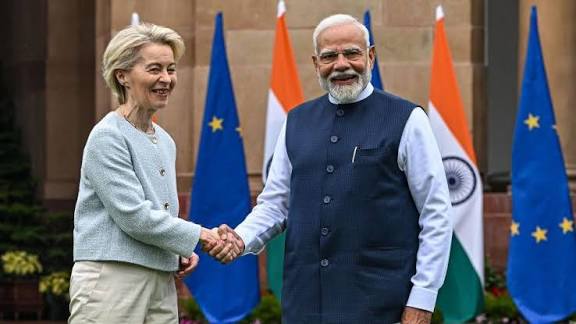
FTA Negotiations Nearing Conclusion
Both sides are in the final stages of negotiations for a Free Trade Agreement (FTA), which they aim to seal by the end of 2025. Talks, which were relaunched in 2022 after nearly a decade-long pause, have gained renewed momentum following global shifts in trade policy. With US President Donald Trump reimposing tariffs, India and the EU have accelerated their efforts to build alternative economic partnerships.
According to officials, the FTA is expected to boost bilateral trade, open up new market opportunities for European companies in India, and enhance India’s access to the EU’s large consumer base. The agreement will also likely address barriers in sectors such as digital trade, green technology, and intellectual property rights.

Beyond trade, the EU is also seeking closer defence cooperation with India. The partnership would focus on joint research, cyber security, maritime security, and supply chain resilience. This is part of a broader EU strategy to diversify its security ties in Asia, reducing dependence on the US and countering China’s expanding influence in the Indo-Pacific.
Indian officials, while welcoming deeper defence cooperation, have reiterated that strategic autonomy remains at the core of New Delhi’s foreign policy. India has historically balanced its ties between the West and Russia, a stance that continues to shape its defence partnerships.
Russia Factor Complicates Talks
Despite the progress, New Delhi’s strong ties with Moscow—particularly in the defence sector—remain a point of concern for the EU. Russia continues to be India’s largest defence supplier, accounting for a significant share of military imports. Since the Ukraine conflict, the EU has pressed partners worldwide to reduce dependence on Russia.
European leaders have acknowledged India’s unique security needs but are keen to ensure that the upcoming FTA and defence partnership align with their broader sanctions and security strategy. Analysts suggest that while Brussels may remain flexible, it will closely monitor India’s engagement with Russia in sensitive areas.
Strategic Significance for Both Sides
For India, a stronger EU partnership offers economic diversification, access to advanced technology, and a counterbalance to China’s economic clout. For the EU, India represents a reliable partner in Asia with growing geopolitical weight, democratic values, and a large market.
Experts say the timing is critical. With global supply chains shifting and trade blocs realigning, both sides see value in securing a long-term framework for cooperation. A successful agreement could significantly elevate EU-India relations and reshape the balance of trade in the region.
Next Steps
Negotiators from Brussels and New Delhi are expected to meet again in the coming weeks to iron out final differences. If concluded on schedule, the EU-India FTA would be one of the most comprehensive agreements for both parties, covering goods, services, investment, and technology collaboration.
The deal is also likely to include commitments on sustainability and climate cooperation, reflecting the EU’s emphasis on green growth. For India, this could translate into greater investment in renewable energy and climate-friendly technology.
Observers believe the partnership has the potential to transform EU-India relations into a cornerstone of global trade and security cooperation in the decades ahead.