
In what appears to be a moment of cautious optimism in an otherwise tense chapter of global trade relations, US President Donald Trump has expressed confidence following the first day of crucial tariff negotiations between the United States and China. Held in the quiet yet diplomatically significant setting of Geneva, Switzerland, these discussions mark a notable step toward rebuilding economic bridges between the two major world powers.

Taking to his platform, Truth Social, President Trump shared that the talks were both “friendly” and “constructive,” and declared that “great progress” had been made. He hinted at a “total reset” in the strained trade relationship, a term that reflects both the urgency and ambition behind the negotiations. “We want to see, for the good of both China and the U.S., an opening up of China to American business,” he wrote, emphasizing mutual benefit over confrontation.
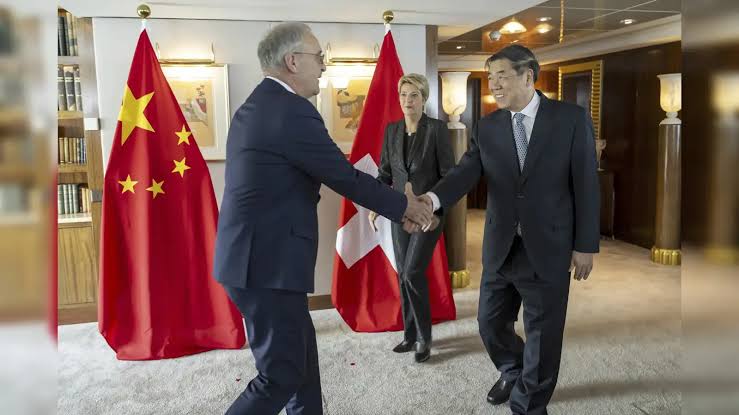
The talks, lasting over 10 hours at the scenic Villa Saladin overlooking Lake Geneva, brought together key officials from both nations. Representing the US were Treasury Secretary Scott Bessent and Trade Representative Jamieson Greer, while Chinese Vice Premier He Lifeng led the delegation from Beijing. Although the atmosphere around the talks was deliberately kept discreet, with no public statements issued and security kept tight, the mood within diplomatic circles has been described as cautiously hopeful.
This meeting comes after a period of escalating tension, which saw the US raise tariffs on Chinese imports to 145%, followed by a 125% retaliatory response from China. These dramatic increases had not only disrupted bilateral trade but also sparked global fears of a prolonged economic downturn. Against this backdrop, the resumption of dialogue—even without immediate outcomes—is being welcomed as a step in the right direction.
While expectations for a swift resolution remain modest, experts view the revival of communication itself as significant. Even a partial rollback of the recently imposed tariffs would send a powerful message of de-escalation, and potentially calm jittery markets. President Trump, long a defender of tough trade tactics, recently signaled some flexibility, suggesting a possible reduction in tariffs depending on ongoing outcomes.
It’s important to note that these trade tensions extend beyond mere numbers. The United States has also used economic leverage to raise broader concerns about issues like intellectual property rights and fentanyl trafficking—issues that have long complicated US-China relations.
Switzerland’s role as host is also noteworthy. While the Swiss economy has so far avoided being directly drawn into the crossfire, the government has expressed concern that continued friction between major trading partners could impact industries vital to their economy, including luxury goods and agriculture.
As the talks are set to continue on Sunday, observers around the world will be watching closely. In a world already grappling with economic uncertainty and geopolitical strain, the potential for reconciliation between two of the globe’s most influential economies offers a rare glimpse of hope. And while the road ahead is uncertain, this “total reset” may just be the beginning of a more balanced and constructive partnership.