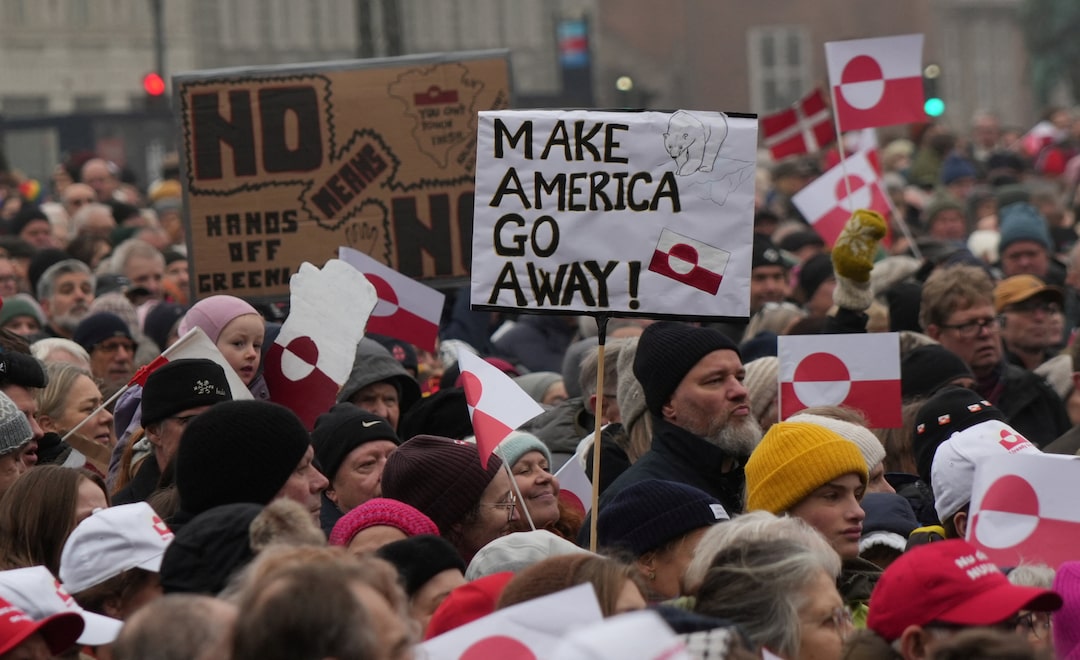
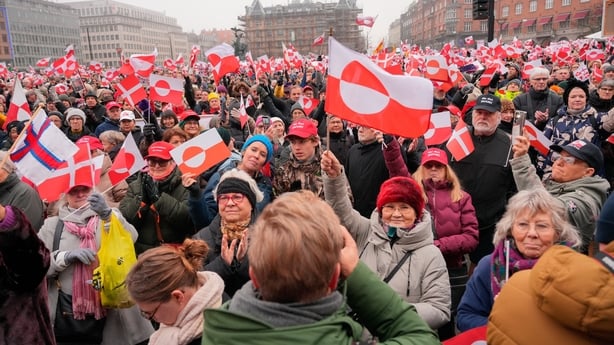
Thousands of demonstrators took to the streets across Denmark and Greenland on Saturday, voicing strong opposition to former US president Donald Trump’s renewed calls for the United States to take control of Greenland. The coordinated protests reflect mounting international unease over sovereignty, Arctic security, and Washington’s increasingly assertive rhetoric toward the strategically vital territory.
 Protests Timed With US Diplomatic Visit
The demonstrations coincided with a visit by a bipartisan US congressional delegation to Copenhagen, where meetings with Danish and Greenlandic officials were scheduled. Activist group Uagut, representing Greenlanders living in Denmark, said the protests aimed to send a “clear and unified message” that Greenland’s democratic institutions and human rights must be respected.
Tensions escalated after Jeff Landry, Trump’s special envoy to Greenland, publicly stated that a deal for Washington to acquire the island “should and will be made.” He added that Trump was “serious” about pursuing control of the autonomous territory, reigniting a debate that first surfaced during Trump’s presidency.
Tariff Threats Deepen Diplomatic Rift
Addressing reporters in Washington, Trump warned that countries opposing his Greenland plans could face economic consequences. He specifically threatened to impose tariffs on nations that do not “go along” with his vision, raising fears of trade retaliation against close US allies.
Although his remarks on Greenland were brief, analysts noted that this marked the second time in a week that Trump invoked tariffs as a geopolitical tool. Earlier, he had floated the idea of imposing a 25% import tax on countries maintaining commercial ties with Iran amid ongoing human rights concerns there.
Nato Allies Step Up Arctic Presence
Trump’s comments have prompted swift reactions from Europe. In recent days, several Nato allies including France, Germany, the United Kingdom, Norway and Sweden have reportedly deployed additional troops to Greenland as a show of solidarity with Denmark and to reinforce Arctic security.
Danish Prime Minister Mette Frederiksen emphasised that Greenland’s defence is a “common concern” for the entire Nato alliance. Her remarks reflect growing European consensus that the island’s status is not merely a bilateral issue, but one with broader implications for transatlantic stability.
Greenland’s Strategic Importance
Greenland occupies a crucial position in the Arctic, rich in rare earth minerals and critical shipping routes increasingly accessible due to climate change. While it remains part of the Kingdom of Denmark, Greenland enjoys substantial autonomy, with its own parliament and control over most domestic affairs.
Any attempt to alter its status without the consent of its people would raise serious legal and ethical questions under international law. Greenlandic leaders have repeatedly stated that the island is not for sale and that decisions about its future rest solely with its residents.
Europe Draws a Line on Sovereignty
European leaders have spent the past year cautiously navigating relations with Trump, balancing security dependence on the US with concerns over tariffs and defence spending demands. However, analysts suggest that Greenland represents a red line.
“This goes to the heart of sovereignty,” said a senior transatlantic security expert, noting that Europe’s credibility depends on defending its own territory. The unfolding protests suggest that public opinion across the region strongly supports that stance.
For India, the developments highlight how Arctic geopolitics are becoming increasingly central to global power dynamics.
As protests continue and diplomatic engagements unfold, Greenland has emerged as a flashpoint in a rapidly shifting world order, where territorial integrity, economic pressure and strategic resources are increasingly intertwined.