 Shaping India’s AI-Ready Workforce
The Guwahati meeting will bring together senior policymakers, academic leaders, industry experts, and practitioners to deliberate on how India can prepare its workforce for an AI-driven future. Discussions will focus on education reform, skilling pathways, and workforce readiness at a time when artificial intelligence is rapidly reshaping jobs, productivity, and learning systems.
Anchored in the principle of treating AI as a public utility, the Working Group aims to design inclusive, scalable, and responsible approaches to AI-led workforce transition. The emphasis, organisers said, is on ensuring that AI strengthens human potential rather than displacing it.
Participation from Government, Academia and Industry
The event will see participation from senior officials of the Assam government, including Shri Syedain Abbasi, IAS, Special Chief Secretary; Shri K. S. Gopinath Narayan, IAAS, Principal Secretary (IT); and Shri Ashwani Kumar, IAS, Director, IT Department. Their presence underscores Assam’s growing role in India’s digital and innovation ecosystem.
Academic leadership from IIT Guwahati will also play a central role. Prof. Jalihal, Director of IIT Guwahati, and Prof. Gautam Barua, former Director of the institute, will join the deliberations along with leading scholars and domain experts from across the country.
From the national AI mission, Smt. Shikha Dahiya, Joint Director, IndiaAI, MeitY, and other senior officials will contribute insights on aligning human capital strategies with India’s broader AI roadmap.
Key Themes and Panel Discussions
The agenda features expert-led panel discussions on some of the most pressing challenges and opportunities in the AI era. These include gender-responsive strategies for managing the AI transition, redefining education for the cognitive age, and building inclusive and empowered digital societies.
Special focus will be placed on the architecture of the National Language Translation Mission, reflecting India’s linguistic diversity and the need for equitable access to AI-driven tools. Another major theme is the “reverse engineering approach” to AI education, which explores how learning systems can be redesigned from real-world outcomes backward.
Together, these sessions will examine how India can reimagine learning models, language access, and skills pathways to ensure that citizens across regions and socio-economic backgrounds are prepared for an AI-enabled economy.
Vision Address and National Context
The inaugural session will feature a Summit Address by Prof. T. G. Sitharam, who will outline the Human Capital vision under the India AI Impact Summit framework. His address is expected to set the tone for how India views AI not merely as a technology challenge, but as a societal transformation requiring thoughtful policy and institutional responses.
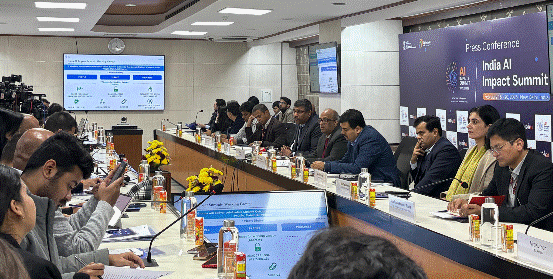
The Guwahati convening is positioned as a key regional and thematic milestone ahead of the India AI Impact Summit 2026, scheduled to be held from February 15 to 20 in New Delhi. The summit will bring together national and global stakeholders to shape the future of inclusive, responsible, and impact-driven AI.
Informing the India AI Impact Summit 2026
Outcomes from the Human Capital Working Group Meeting are expected to directly inform the deliberations at the upcoming summit. Recommendations emerging from Guwahati will help frame national strategies on education, skilling, and workforce resilience in the age of artificial intelligence.
By hosting this important dialogue, Guwahati and IIT Guwahati reinforce the growing role of the Northeast in India’s technology and policy landscape. The meeting also signals India’s commitment to building a future-ready workforce that can thrive alongside AI while upholding principles of inclusion, equity, and responsible innovation.