

Highlighting the unique role of legislatures, Shri Harivansh said that Parliaments and State Assemblies are custodians of official policy documents, including legislative debates, budget discussions, rulings and procedural precedents. These documents, he noted, form the intellectual foundation of democratic governance and are laid before the House as part of its formal record.
However, he pointed out that much of this information currently remains scattered across ministries and departments, limiting its accessibility. AI, he said, offers an opportunity to organise and integrate this vast repository into a single, easily accessible knowledge platform.
Need for Parliament–State Coordination
Calling for synergy between Parliament and State Legislatures, the Deputy Chairman said coordinated efforts would allow institutional knowledge from across the country to be pooled effectively. Such collaboration, he explained, would help develop AI systems that serve both Parliament and State Legislatures with greater accuracy and consistency.
He advocated the creation of a shared “Data Lake” comprising legislative documents, debates, vocabularies and procedural records from across India. This, he said, would enable AI tools to be trained in a manner that reflects India’s diverse legislative traditions and multilingual context.
Knowledge, Not Just Algorithms
Emphasising the importance of context, Shri Harivansh remarked that the suitability of AI for parliamentary use depends not merely on its algorithmic strength but on the knowledge it is trained upon. Parliamentary AI, he said, must be trained within the institution using carefully curated legislative data.
While skills and technical expertise can be outsourced or acquired externally, he noted that parliamentary knowledge is deeply embedded within institutions and has evolved over decades through debates, conventions and constitutional practices. Preserving this uniqueness, he said, is essential while adopting advanced technologies.
Human Oversight Remains Essential
The Deputy Chairman also called for a hybrid approach where humans retain oversight over AI training and outputs. Such a mechanism, he said, would ensure accountability, prevent misuse and maintain the integrity of legislative processes.
He stressed that AI should assist decision-making rather than replace human judgement, particularly in institutions that form the backbone of democratic governance.
Current AI Initiatives in Parliament
Shri Harivansh shared insights into how Parliament has already begun experimenting with AI-enabled tools. These include AI-based transcription and simultaneous interpretation systems that allow Members of Parliament to access House proceedings and official documents in languages of their choice.
He added that AI is also being explored for routine administrative tasks such as scrutinising the admissibility of questions for Question Hour, searching past precedents and locating relevant rulings. These applications, he said, can significantly reduce manual workload and improve efficiency.
Capacity Building and Awareness
Beyond technology, the Deputy Chairman emphasised the need for capacity building and orientation programmes for legislators and staff. Familiarity with digital tools, he said, is essential to ensure that technology is used effectively and responsibly.
The conference also deliberated on broader issues such as strengthening accountability mechanisms and enhancing the institutional capacity of legislatures.
Conference Context
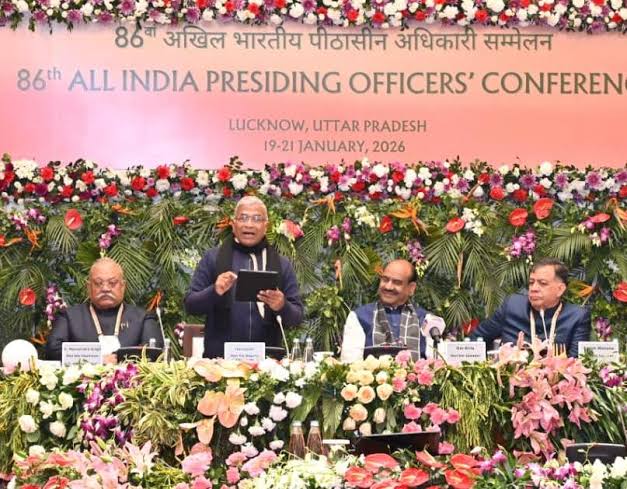
The 86th All India Presiding Officers Conference commenced on January 19 in the presence of Uttar Pradesh Governor Smt. Anandiben Patel and Lok Sabha Speaker Shri Om Birla. The event brings together Presiding Officers from Parliament and State Legislatures to deliberate on institutional reforms and best practices.