
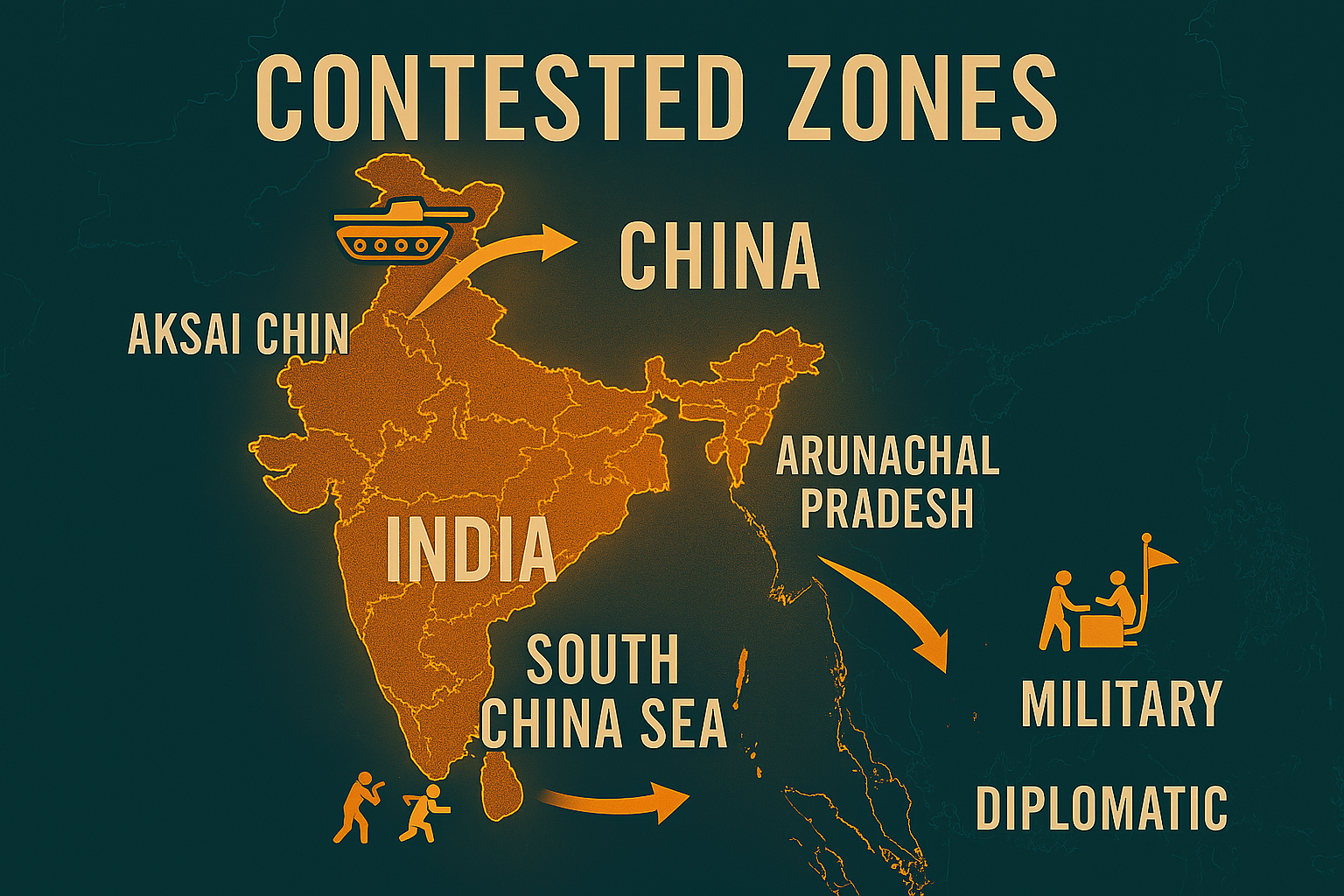
From the Himalayas to the South China Sea, China’s territorial claims are pushing neighbors closer — but not always to Beijing
In recent years, China’s aggressive stance on territorial disputes has significantly impacted regional diplomacy across Asia. These conflicts — stretching from the Himalayas to the South China Sea — are not just about lines on a map. They are changing strategic alliances, trade partnerships, and regional stability.
The Himalayas: Tensions with India Escalate
China and India share a 3,488-kilometer disputed border. Skirmishes like the Galwan Valley clash in 2020, which resulted in the deaths of soldiers on both sides, have severely strained ties.
Beijing’s occupation of Aksai Chin and its recent infrastructure buildup near Arunachal Pradesh, which China claims as “South Tibet,” continue to antagonize India. These actions have pushed New Delhi to strengthen its border defenses and deepen cooperation with QUAD partners such as the U.S., Japan, and Australia.
The South China Sea: A Flashpoint with Southeast Asia
In the maritime realm, China has aggressively pursued its “nine-dash line” claim, asserting ownership over most of the South China Sea. This overlaps with the Exclusive Economic Zones (EEZs) of nations like Vietnam, the Philippines, and Malaysia.
China’s construction of artificial islands and militarization of the region have drawn international condemnation. Countries like the Philippines, once cautious, are now inviting U.S. military presence back onto their soil.
📌 The 2016 ruling by the Permanent Court of Arbitration invalidated China’s expansive claims — a decision Beijing continues to ignore.
Bhutan, Nepal, and the Subtle Squeeze
Beyond its larger neighbors, China has been quietly exerting influence on smaller Himalayan countries. In Bhutan, recent reports suggest Beijing has constructed villages in disputed territory. In Nepal, Chinese investments are growing — but so are local fears of dependence.
These moves seem intended to create buffer zones or pressure points near India’s strategic borders.
Why Diplomacy Is Being Rewritten
China’s assertiveness is creating an unexpected side effect — a realignment of smaller Asian countries that were once neutral or pro-Beijing. Many now seek deeper engagement with India, the U.S., and ASEAN.
For example:
- Vietnam and Indonesia have quietly boosted military ties with Western powers.
- Japan and South Korea have increased military spending and are more vocal about Chinese aggression.
- India is emerging as a central player in regional forums like ASEAN and I2U2 (India-Israel-UAE-U.S.).
Strategic Takeaway
China’s border disputes, once regional irritants, are now shaping global alliances. In attempting to secure dominance, Beijing may have inadvertently sparked a counter-coalition of regional actors.
For India, this presents both a challenge and an opportunity. A tougher neighborhood requires sharper diplomacy and enhanced defense. But it also positions New Delhi as a trusted alternative to Chinese hegemony.
Final Thoughts
The future of regional diplomacy in Asia is being reshaped not by summits or trade pacts, but by bulldozers on borders and frigates in contested waters. As China pushes harder, the rest of Asia is pushing back — and in doing so, redrawing the political map of the 21st century.