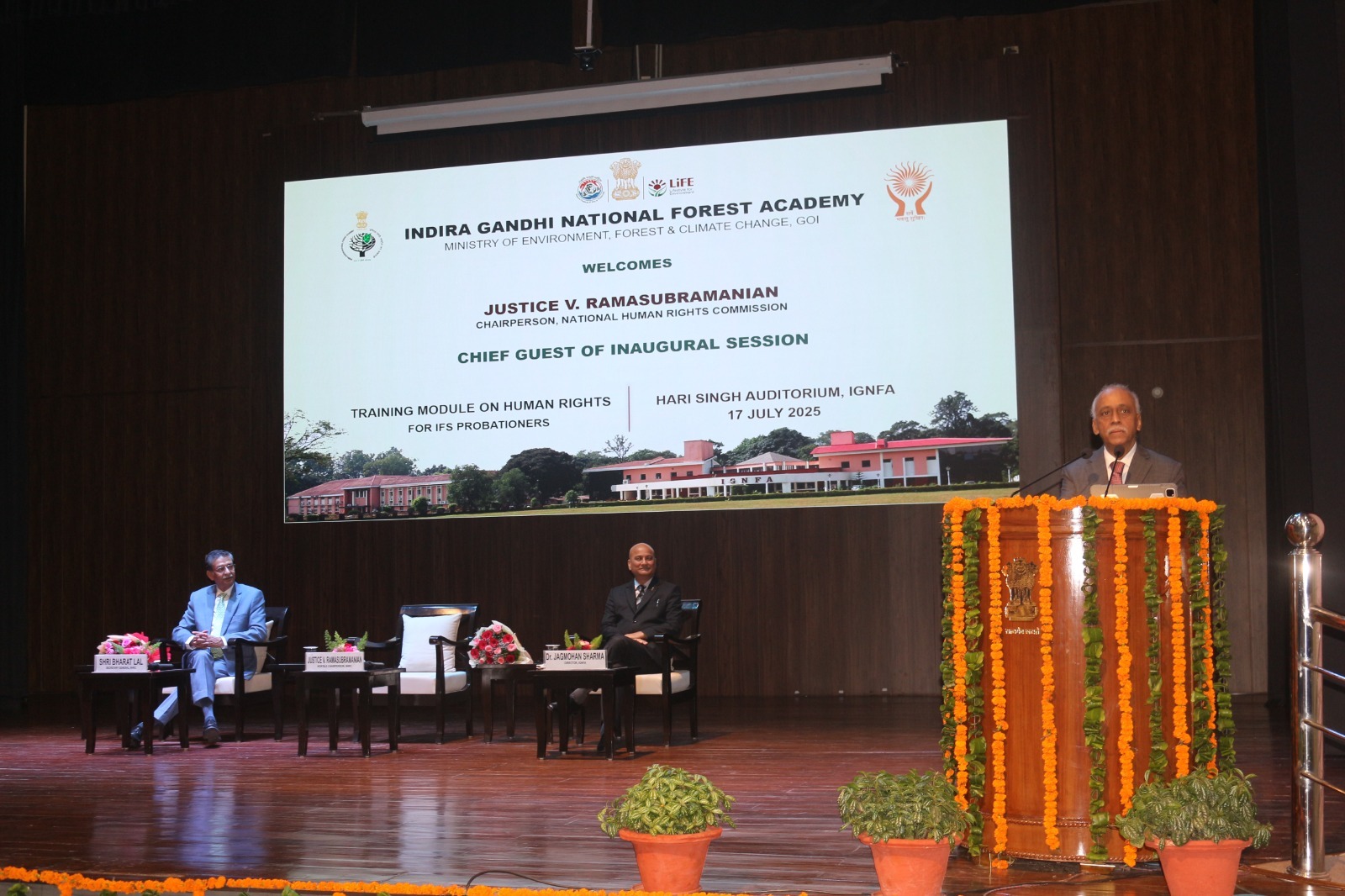
The National Human Rights Commission (NHRC) and the Indira Gandhi National Forest Academy (IGNFA) have come together to launch a landmark initiative. A 2-day training programme on human rights for Indian Forest Service (IFS) probationers began on July 17, 2025, in Dehradun.
 Justice Ramasubramanian Urges Citizens to Protect Nature
Inaugurating the event, NHRC Chairperson Justice V. Ramasubramanian emphasized that protecting the natural environment is not just the government’s duty—it is a constitutional responsibility of every citizen.
He cited Article 48A and Article 51A(g) of the Constitution, reminding officers and citizens alike of their shared role in environmental conservation. Justice Ramasubramanian also walked participants through the historical roots of human rights— from the Charter of Cyrus to the Universal Declaration of Human Rights (1948).
He introduced the idea of four generations of human rights: civil and political, socio-economic, collective, and digital-environmental rights. He warned that the rise of AI, biotechnology, and digital surveillance presents new ethical challenges that young officers must be prepared to tackle.
India’s Commitment to Human Rights Runs Deep
NHRC Secretary General Shri Bharat Lal delivered the keynote address. He spoke passionately about India’s civilisational values of compassion, inclusion, and non-violence.
He cited examples like Mahatma Gandhi, Raja Ram Mohan Roy, and Dr. B.R. Ambedkar—all early advocates of human rights and social justice.
Shri Lal highlighted the roles of Fundamental Rights, Directive Principles of State Policy, and tools like writs under Articles 32 and 226. He also underlined the impact of Public Interest Litigations (PILs) in ensuring justice for the underprivileged.
Empowering Officers to Serve With Compassion
Speaking to the young probationers, Shri Bharat Lal encouraged them to prioritize the inclusion of forest-dwelling communities. “Protecting the forest means protecting the people who live in and depend on it,” he said.
The NHRC’s accessible complaint system, multilingual outreach, suo motu investigations, and fieldwork through Special Rapporteurs and Core Groups were highlighted as pillars of human rights protection in India.
He urged officers to practice empathy and ensure that policies are not only effective but also just and inclusive.
IGNFA’s Vision: Linking Forests with Human Dignity
Dr. Jagmohan Sharma, Director of IGNFA, explained the training’s objective: integrating the principles of human rights into environmental governance.
He emphasized that India’s forest officers must understand and respect the legal and moral rights of tribal and marginalized communities. This understanding, he said, is vital for sustainable conservation.
He acknowledged the NHRC’s role in promoting dignity for the country’s most vulnerable populations.
Experts Join Hands to Guide Future Leaders
The two-day programme features 13 sessions led by top experts, including:
- Shri Rajiv Jain, Former NHRC Member
- Shri Rajiv Kumar, Former Chief Election Commissioner
- Dr. S. P. Yadav, DG, International Big Cats Alliance
- Ms Sunita Narain, DG, Centre for Science and Environment
- Smt Meenakshi Negi, PCCF (HoFF), Karnataka
- Shri R. R. Rashmi, Former Special Secretary, MoEFCC
The sessions focus on legislation, case studies, conservation ethics, and best practices from across India.
Extending the Mission Beyond Dehradun
This initiative follows similar NHRC training sessions for IPS probationers at SVPNPA, Hyderabad, and Indian Foreign Service officers at the Sushma Swaraj National Institute of Foreign Service, New Delhi.
By focusing on young civil servants, the NHRC is ensuring that awareness of human rights becomes second nature to those who shape the nation’s future.
Conclusion: Building a Just, Green, and Inclusive India
This two-day programme marks a significant step in mainstreaming human rights within forest and environmental governance. It reflects India’s belief that rights, responsibility, and conservation must go hand in hand.
As these young officers step into their roles, the lessons learned in Dehradun will resonate in every forest they protect and every community they serve.