
‘Sikaar’: A Journey of Emotion and the Last Onscreen Legacy of Zubeen Garg
The conference opened on an emotional note as director Debangkar Borgohain honoured the memory of musician-actor Zubeen Garg, the beloved Assamese icon who passed away just weeks before the festival. Borgohain recalled approaching Garg only for music, until the artist, moved by the story, insisted on playing the lead role.
Calling Sikaar “the last film of Zubeen Garg released during his lifetime,” the director spoke with quiet poignancy about the loss. He shared how 70% of the film was shot in London a first for Assamese cinema while he himself directed remotely from Guwahati, often coaching actors and crew “under mosquito nets” during livestreamed schedules.
He noted the overwhelming reception at IFFI, with houseful shows reflecting a growing national admiration for Assamese storytelling. Yet Borgohain raised concerns about visibility for regional cinema on OTT platforms, acknowledging their vast reach but adding that “regional films rarely get the spotlight they deserve.”


In contrast to the emotional weight of Sikaar, the team behind Nilgiris – A Shared Wilderness brought awe and scientific curiosity to the hall. Associate Producer Adarsh N C described the extraordinary patience needed to create a wildlife documentary shot in ultra-high-resolution formats such as 8K and 12K.
“The wildlife are the film’s true stars. They don’t arrive on time. There are no retakes,” he said, revealing that sometimes a single shot required three months of waiting. The documentary captures rare species across the Nilgiri Biosphere, one of India’s most complex ecological regions shaped over billions of years.
Sri Harsha from the team recalled the unpredictability of wildlife filmmaking, with researchers constantly tracking animal movement to guide the crew. The film, they said, is also about people and coexistence capturing the species living quietly in backyards and villages.
When asked about influence from global giants such as Nat Geo or BBC Earth, the makers proudly emphasised that the film is entirely Made in India. OTT platforms have shown interest, they confirmed, but the team insists that audiences must first experience Nilgiris on the big screen.
‘Mukkam Post Bombilwadi’: Where Wartime Chaos Meets Classic Marathi Comedy
The energy in the room shifted again as director Paresh Mokashi and producer Bharat Shitole discussed their uproarious wartime satire Mukkam Post Bombilwadi. Adapted from their iconic stage play, the film is set in 1942, where a tranquil coastal Maharashtrian village finds itself caught between the Quit India Movement and the disruptions of World War II.
Mokashi, known for his signature wit, explained how humour deepens rather than diminishes serious themes. “Great comedies have been made on poverty,” he noted, adding that satire allows difficult truths to be seen with greater clarity.
On the debate around OTT and regional cinema, both filmmakers stressed that strong local support must precede global expansion. While acknowledging wider opportunities offered by streaming platforms, they argued that regional films still struggle for equal visibility online.
A Tribute to India’s Cinematic Diversity
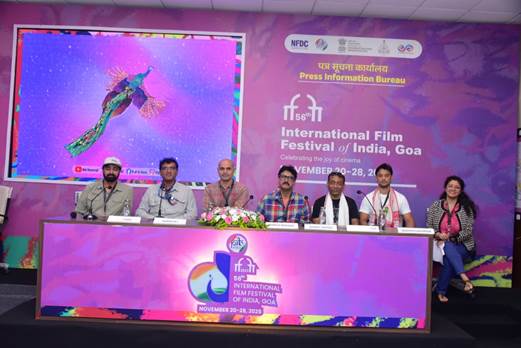
The press conference showcased three radically distinct cinematic worlds the emotional journey of Sikaar, the ecological grandeur of Nilgiris, and the spirited humour of Bombilwadi. Yet they converged on one common theme: Indian cinema’s evolving ability to honour authenticity, embrace experimentation and celebrate stories from every corner of the country.
As IFFI continues to bring together filmmakers, audiences and cultures, sessions like these reinforce why it remains South Asia’s premier celebration of cinema.