
India Charts Unified Health Path with First NOHM Workshop
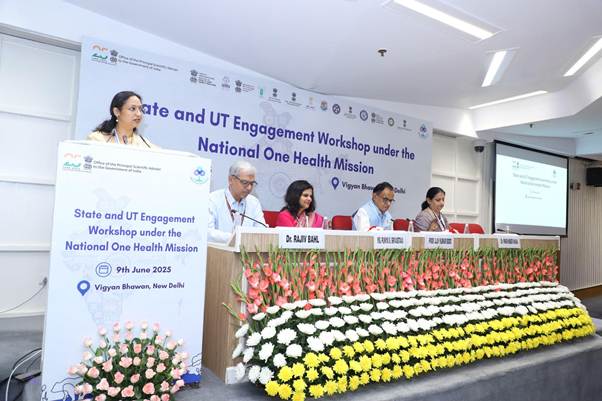
In a landmark move toward holistic health governance, India concluded its first State and Union Territory Engagement Workshop under the National One Health Mission (NOHM) on 9th June 2025. Chaired by Prof. Ajay Sood, Principal Scientific Adviser (PSA) to the Government of India, the workshop marked a collaborative step in unifying human, animal, and environmental health strategies.
The event laid the groundwork for cross-sectoral policy, institutional innovation, and on-ground readiness for future health challenges—infectious or otherwise.

Youth and Technology Take the Lead
The workshop also witnessed the launch of two major initiatives:
-
The workshop included the launch of two major initiatives:
-
Youth Engagement Program
-
National One Health Dashboard
Prof. Sood emphasized the importance of fresh perspectives from India’s youth. Ms. Punya Salila Srivastava, Secretary, Ministry of Health and Family Welfare, urged optimal use of inter-departmental resources.
Youth Engagement Program
-
-
National One Health Dashboard
Prof. Sood emphasized the importance of fresh perspectives from India’s youth, while Ms. Punya Salila Srivastava, Secretary, Ministry of Health and Family Welfare, urged optimal use of inter-departmental resources.
The Youth Engagement Program aims to tap into the energy and innovation of young Indians through state platforms, hackathons, and academic programs. Prof. Sood proposed introducing dedicated One Health courses on iGoT Karmayogi to foster structured learning.
The One Health Dashboard, now available at psa.gov.in, will act as a repository of One Health efforts across states, ministries, and multilateral bodies, enabling data transparency, coordination, and policy formulation.
Four Critical Themes Drive Discussion
The workshop was structured around four thematic sessions led by India’s top scientific minds:
-
Governance & Policy – Led by Dr. Renu Swarup
-
Surveillance Systems – Chaired by Dr. N. K. Arora
-
Outbreak Investigation & Response – Led by Lt. Gen. Dr. Madhuri Kanitkar
-
Capacity Building & Data Sharing – Overseen by Prof. Vijay Chandru
These sessions fostered valuable dialogue between state officials, academic experts, and military medical units. Each theme focused on identifying operational gaps, governance hurdles, and future strategies.
States Showcase Local Models
Representatives from Kerala and Gujarat, chosen for NOHM governance on a rotational basis, presented local One Health frameworks. Their case studies covered syndromic surveillance systems, governance models, and institutional innovations.
The interaction encouraged other states to replicate best practices and highlighted the importance of decentralised planning for national preparedness.
Mock Drill Brings Realism to the Table
The day concluded with a simulation exercise designed to test outbreak preparedness. Spearheaded by NCDC, NSCS, AMC, RVC, and NIV, the drill tested intersectoral coordination and command responses to a mock zoonotic outbreak.
The simulation brought together real-time decision-making by departments like ICMR, DAHD, Army Medical Corps, and more. Teams formulated strategies covering containment, communication, and medical countermeasures.
A Call for State-Level Dashboards
Prof. Sood urged states and UTs to create their own state-specific One Health dashboards, linked to the central portal. He also highlighted the importance of standardised health data, interoperability, and public accessibility for integrated disease management.
To institutionalize the effort, the National Centre for Disease Control (NCDC) and ICMR will continue to provide technical support to states.
Poster Session: Innovation in Action
The workshop hosted a poster exhibition where states, multilateral bodies, and research institutions showcased their initiatives—ranging from AMR surveillance to eco-health monitoring.
This participatory format not only encouraged knowledge-sharing but also helped build a network of health innovators.
Way Forward
The success of the workshop signals a new era in India’s health governance. With states as key drivers and youth as change agents, the One Health Mission is poised to build a resilient, tech-enabled, and community-participative health infrastructure.
Prof. Sood’s closing words summed it best: “One Health is not a program. It is a mindset.”