Bringing science and institutions together
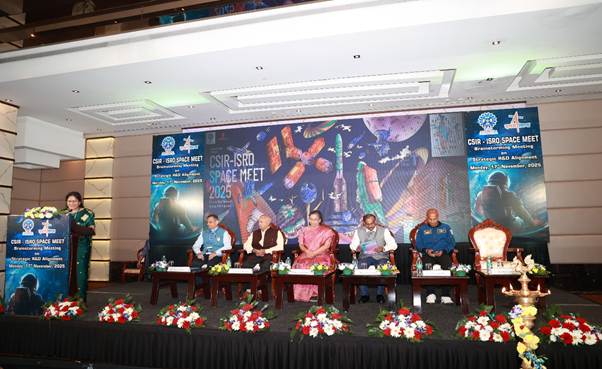
Dr. N. Kalaiselvi, Secretary DSIR and Director General of CSIR, opened the meet by highlighting CSIR’s role in materials research, testing and aerospace technologies that underpin crewed mission readiness. She said the meet would enable practical knowledge sharing, identify capability gaps and accelerate indigenous innovation in support of national space objectives.
Dr. V. Narayanan, Secretary, Department of Space and Chairman of ISRO, delivered the strategic address, stressing that Gaganyaan and future human missions demand coordinated inputs across ministries, R&D institutions, academia and industry. He outlined priorities including next-generation crew safety systems, advanced life support, and scientific payloads designed for human-centric research beyond low Earth orbit.
 Astronaut insights and operational readiness
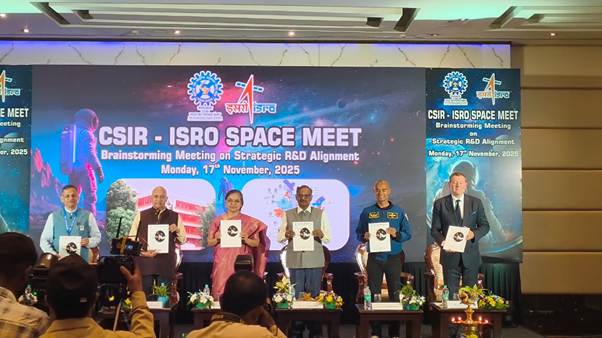
Experience-sharing sessions were a highlight. Group Captain Prasanth B. Nair (ISRO astronaut) presented detailed briefings on astronaut training, microgravity simulation protocols, operational readiness and recovery frameworks. His account stressed practical training timelines, simulation fidelity and crew-support logistics.
Wing Commander Rakesh Sharma (Retd.), India’s first astronaut, reflected on his 1984 Soyuz mission and paid tribute to the laboratories and testing facilities contributing to India’s aerospace capability. Both veterans emphasised that India’s human spaceflight effort is mission-centric and oriented towards peaceful exploration and scientific return.
International expertise and collaborative research
The meet featured global contributions: a video message by ESA astronaut Jean-Francois Clervoy underlined the value of international cooperation, while experts from ESA, JAXA and academic institutions shared research on physiology, human–technology interfaces and life-support systems. Presentations by Dr. Lucia Roccaro (ESA) and Dr. Akiko Otsuka (JAXA) showcased multi-agency approaches to crew health and mission science.
Domestic academics, including Prof. Pradipta Biswas (IISc), presented on human–technology interaction and interface design for crewed missions crucial for habitability, control systems and ergonomics inside crew modules and habitats.
Technology priorities and capability gaps
Technical sessions mapped critical gaps in materials, environmental control, crew health monitoring and emergency response. CSIR-NAL and partner labs highlighted advances in aerospace-grade materials, testing protocols and ground-based validation facilities that can support life-support and structural subsystems for crewed vehicles.
Speakers emphasised the need to scale testing infrastructure, increase interdisciplinary projects and create fast-track pathways from lab prototypes to flight-qualified systems. Cross-agency coordination emerged as a recurring theme to avoid duplication and prioritise mission-critical developments.
Training, research partnerships and the road ahead
The meet concluded with commitments to strengthen science-technology convergence, institutional linkages and mission-oriented research. Participants agreed on expanded training programs, academic exchanges, and collaborative projects that align CSIR’s material and engineering expertise with ISRO’s mission requirements.