 Platform for Deployable and Scalable AI
The India AI Impact Expo 2026 is designed as a deployment-first platform, focusing on AI solutions that demonstrate measurable societal and economic impact.
Organisations submitting the “Exhibit with Us” Expression of Interest will undergo a review process, after which shortlisted exhibitors will receive confirmation emails detailing booth allocation, pavilion themes and participation costs.
Scale and Global Participation
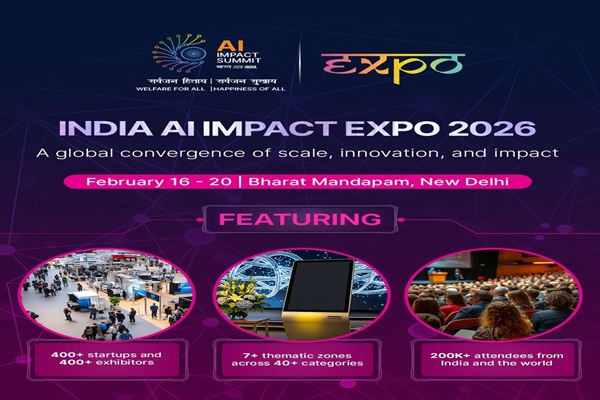
Spread across over 70,000 square metres and 10 exhibition halls, the Expo is expected to host more than 400 exhibitors, representing startups, corporates, academia, central ministries, state governments and international pavilions.
Participation is anticipated from 19+ Indian states and 10+ countries, with footfall projections exceeding 150,000 visitors, making it one of the largest AI-focused expos ever organised in India.
Seven Chakra-Themed AI Pavilions
The Expo is organised around seven chakra-inspired thematic pavilions, covering over 40 AI categories. These pavilions reflect India’s holistic approach to artificial intelligence, combining innovation with inclusivity and governance.
The themes include AI for Economic Development and Social Good, Human Capital and Workforce Skilling, Inclusion and Language Accessibility, Safe and Trusted AI, Resilience and Resource Efficiency, Science and Research Acceleration, and Democratization of AI Resources.
Key Highlights and Knowledge Exchange
Visitors and exhibitors will benefit from live product demonstrations, B2B meetings, networking lounges and curated collaboration zones. The Expo will also host masterclasses and sector-specific knowledge sessions led by Indian and global AI experts.
One of the major highlights will be the launch of eight indigenous AI foundation models, reinforcing India’s commitment to technological self-reliance and ethical AI development.
Strengthening India’s Global AI Position
By connecting innovators, investors, policymakers and global stakeholders, the India AI Impact Expo 2026 aims to accelerate AI adoption across sectors such as healthcare, agriculture, climate action, education, governance and workforce transformation.