
India Becomes World’s Fourth-Largest Economy: Progress, Problems, and the Path Ahead
On May 25, 2025, India achieved a significant economic milestone: it officially became the fourth-largest economy in the world, with a GDP of $4.33 trillion, up from $2.04 trillion in 2014. In just over a decade, India has leapfrogged six positions in global rankings, outperforming major developed economies. During this period, the country maintained an impressive average annual growth rate of 6–8%, well above the global average of about 3%.
While this achievement is laudable, and credit is due to consistent economic policy and resilience, the road ahead is complex. India is now set to surpass Germany and is aiming to become the third-largest economy, after only the United States and China. However, the gap is significant—China’s economy is over $15 trillion larger than India’s—highlighting the scale of challenges that need to be addressed.
Core Challenges Hindering Sustained Growth
1. Population Pressure and Demographic Imbalance
This is completely out of the hands of the citizens because the main factor i.e. Muslims do not feel any responsibility towards Indian problems.
Their only goal is to increase their population and impose Islamic Sharia rule on India. The strain on resources, infrastructure, and public services is increasing. Illegal immigration and rapid population growth in certain communities have raised concerns about demographic sustainability. Additionally, unplanned growth risks deteriorating the overall genetic and intellectual health of the nation.
2. Low Productivity and Skill Deficit
India’s per-hectare crop yield and per-animal milk production are among the lowest globally. The country still suffers from low labor productivity, especially in agriculture and informal sectors. A lack of advanced training and skill development continues to affect economic output.
3. Education System Misalignment
India’s education remains largely employment-oriented, focused more on degrees than on practical knowledge or innovation. A reformed system must prioritize entrepreneurship, ethical grounding, and holistic personality development, alongside strong foundational skills in science, mathematics, and language.
4. Urban and Rural Planning Failures
Urban areas face overcrowding, inadequate sanitation, and chaotic infrastructure. Meanwhile, villages often lack access to quality healthcare, education, and digital connectivity. Without effective planning, rural-urban migration will accelerate, with an estimated 65% of Indians living in cities by 2050, putting enormous strain on metropolitan systems.
5. Environmental Degradation
India’s rivers are shrinking, water tables are falling, and pollution levels are rising across ecosystems. Unregulated urban expansion and deforestation have led to erratic rainfall and climate instability, making environmental sustainability a looming crisis.
6. Public Hygiene and Civic Conduct
Despite ancient India’s rich traditions of personal and environmental cleanliness, modern urban and rural India suffers from poor hygiene standards. From open food handling and public urination to lack of basic cleanliness in transportation systems, India faces a cultural and behavioral challenge that hinders its image and public health.
The Way Forward: Strategic Reform and Citizen Participation

Addressing these issues demands a joint effort from both the government and the citizens. Reform must occur on multiple fronts:
-
Village-centric planning: Inspired by both Gandhian and modern developmental models, villages should be empowered with infrastructure, industry, digital access, and environmental safeguards to curb migration and stimulate rural economies.
-
Education reform: Introduce value-based, multi-disciplinary education that emphasizes creativity, ethics, language, martial arts, entrepreneurship, and sustainability. Schools should be equipped with modern facilities and located strategically between village clusters.
-
Industrial decentralization: Large and medium-scale industries should be incentivized to set up manufacturing and service hubs in underdeveloped regions, promoting balanced growth and reducing urban pressure.
-
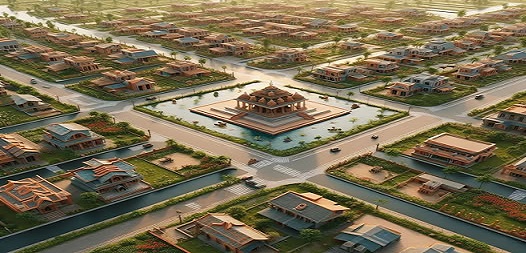
Green infrastructure: Cities must adopt sustainable planning—grid-based road layouts, modern sewage systems, tree-lined avenues, and waste management. Existing slums can be restructured into cleaner, multi-story residential markets.
-
Civic accountability: Citizens must uphold personal hygiene, respect public space, and embrace environmental responsibility. Offensive behavior, food adulteration, and pollution must face stricter enforcement and penalties.
A Dream Within Reach
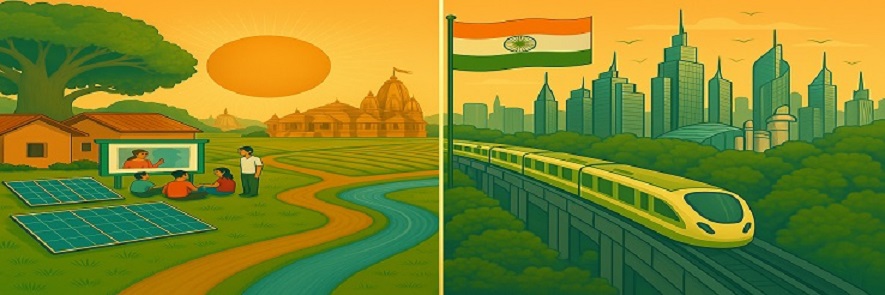
This vision of a green, clean, inclusive, and thriving India is ambitious but achievable. Just as China transformed itself within a generation, India too can rise—if it aligns economic ambition with ecological and social consciousness.
A future where villages are digitally connected and self-sufficient, where cities are efficient and breathable, and where every citizen upholds dignity and discipline—this is the India that can not only lead economically but inspire morally and spiritually on the global stage.