
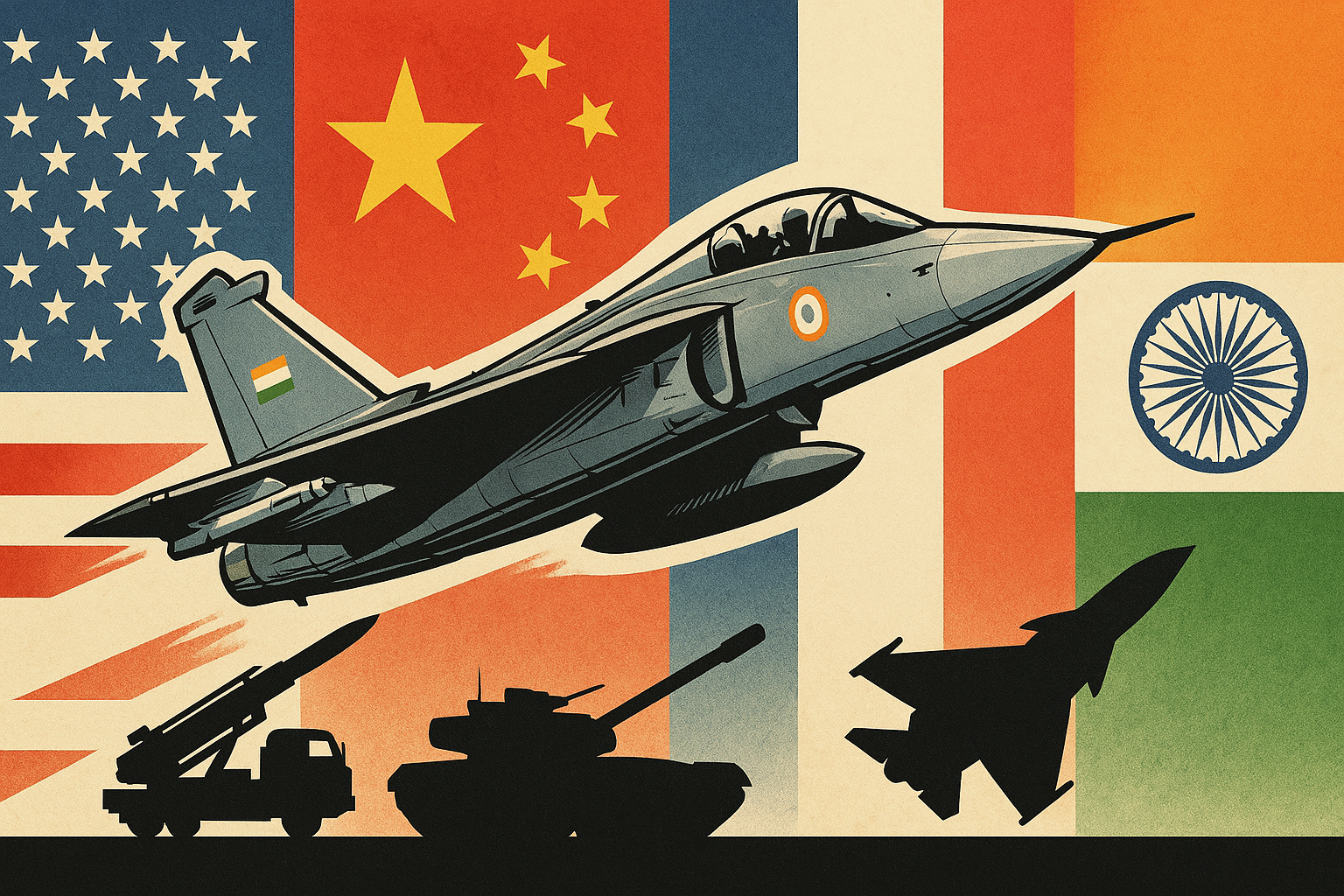
As global alliances falter and neighbors hedge their bets, India must chart its own sovereign path forward—with strength, clarity, and decisive policy.
In the wake of Operation Sindoor, a strategic air campaign that demonstrated India’s military prowess, Prime Minister Narendra Modi’s recent public appearances—from his ‘Mann Ki Baat’ broadcast to his speeches at mass rallies—reveal a visible shift in tone. For the first time, subtle anger and frustration have crept into his otherwise composed demeanor.
This change is not just performative. Recent policy actions—tightening control on foreign-funded NGOs, increased scrutiny of religious institutions such as madrasas, and the abrupt cancellation of NSA Ajit Doval’s scheduled Russia trip—reflect a government recalibrating its strategic stance.
Perhaps the most symbolic sign of this shift is the call for a boycott of foreign goods. Far from a populist appeal, it signals deep-rooted dissatisfaction with the diplomatic posture of global powers, especially in the wake of India’s success in Operation Sindoor.
A Subtle Rejection from ‘Friends’
India’s diplomatic discomfort seems rooted in the lukewarm support or subtle cold-shouldering by its so-called allies—France, Russia, and the United States. The Western world, though impressed by India’s operational precision, may not be entirely comfortable with the rise of a new, self-assured military power outside its traditional spheres of influence.
This hesitation is not new. The world is divided—three continents (Europe, North America, and Oceania) remain largely under Western geopolitical control. Even Russian President Putin, despite his current anti-West alignment, culturally identifies with Europe. The subtle racism and sense of superiority still ingrained in many Western outlooks may explain why India’s military success causes unease rather than applause.
China’s Realpolitik vs. India’s Diplomatic Restraint
China, unlike India, has long recognized Western skepticism and built a self-reliant, opaque, and defensive governance model. Despite aggressive territorial ambitions, China’s insulation from Western influence offers a strategic lesson: Do not rely on others for your survival or strength.
India, while maintaining open markets and diplomatic cordiality, is yet to adopt this self-first mindset in totality.
India’s Strengths—and Its Structural Hurdles
India is no longer a dependent nation. Its naval capabilities are largely indigenized, and land forces can be adequately supplied domestically. In space, missile, and satellite technology, India stands among global leaders. However, air force modernization—particularly jet engine manufacturing and next-gen aircraft production—remains a technological bottleneck.
Compounding this issue is India’s volatile neighborhood. Countries like Pakistan, Bangladesh, and Maldives, bound by ideological differences, are unlikely long-term allies. Others—Nepal, Bhutan, and Sri Lanka—continue to flirt with China for economic benefits, occasionally leveraging India’s generosity while entertaining China’s strategic advances.
India must assert a clear doctrine—akin to the American Monroe Doctrine—making it clear that nations within its neighborhood cannot expect Indian assistance while offering strategic assets or territory to its adversaries.
The Road to Real Independence

The only way forward is total self-reliance in defence, agriculture, and industry. For this, India must do more than manufacture; it must nurture and retain talent. This may require bold steps: ending outdated reservation policies in technical fields, offering competitive salaries to engineers and scientists, and, if necessary, legal mandates to ensure critical skills are deployed within India.
The Final Barrier Is Within
Ironically, the greatest threat to India’s self-sufficiency may not come from outside—but from within. An internal bloc of liberal-secular Hindus and pro-Pakistan elements, often numbering in tens of millions, resist a strong nationalist approach. This internal ideological friction may be Prime Minister Modi’s most frustrating obstacle.
In the boycott of foreign goods, one can sense his underlying exasperation. It is not just a call for economic nationalism—it is a declaration that India must walk alone if it must, but it will do so with its head held high.