

New Delhi, February 23, 2026: India and Brazil have signed a landmark Traditional Knowledge Digital Library (TKDL) Access Agreement, strengthening global efforts to prevent biopiracy and improve patent examination standards. The agreement enables Brazil’s patent office to access India’s TKDL database, reinforcing cooperation in intellectual property rights and traditional knowledge protection.
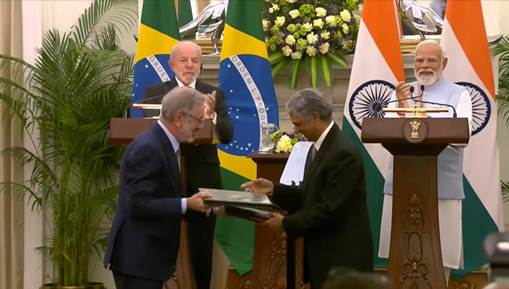

The cooperation arrangement was formalised between Brazil’s National Institute of Industrial Property (INPI) and India’s Council of Scientific and Industrial Research (CSIR). The exchange took place in the presence of Brazilian President Luiz Inácio Lula da Silva and Prime Minister Narendra Modi on February 21, 2026.
President Lula is on a State Visit to India from February 18 to 22, coinciding with the India AI Impact Summit 2026 and several bilateral meetings. Both leaders welcomed the agreement as a significant step in deepening strategic ties between the two nations.
The document was exchanged by Márcio Fernando Elias Rosa, Brazil’s Deputy Minister of Development, Industry, Trade & Services, and Periasamy Kumaran, Secretary (East), Ministry of External Affairs.
What the TKDL Access Means for Brazil
Under the agreement, Brazil’s patent office will gain access to India’s TKDL database during patent examination and grant procedures. This will help Brazilian examiners assess prior art more effectively and avoid granting patents based on knowledge that already exists in traditional Indian systems.
The TKDL serves as a defensive protection mechanism, preventing the wrongful patenting of traditional remedies and practices. By accessing this database, Brazil aims to enhance the quality and efficiency of its intellectual property evaluation system.
With Brazil joining the framework, the number of international patent offices with TKDL access has now increased to eighteen.
India’s Fight Against Biopiracy
India established the Traditional Knowledge Digital Library in 2001 as a collaborative initiative between CSIR and the Ministry of AYUSH. Its core objective is to prevent misappropriation of India’s rich medicinal and cultural heritage.
The database contains over 5.2 lakh documented formulations and practices drawn from Ayurveda, Unani, Siddha, Sowa Rigpa and Yoga. These are translated into modern scientific terminology and made available in English, German, French, Japanese and Spanish to overcome language barriers in global patent systems.
Access to TKDL is granted to patent offices under strict Non-Disclosure Agreements, ensuring secure and controlled usage.
Proven Global Impact
The TKDL is widely regarded as a global benchmark in protecting traditional knowledge. According to official data, more than 375 patent applications worldwide have been revoked, rejected, amended, withdrawn or abandoned after evidence from the TKDL was presented.
This proactive model has positioned India as a leader in safeguarding indigenous knowledge systems against commercial exploitation without due recognition or benefit sharing.
Institutional Oversight and Future Cooperation
The agreement will be implemented under the guidance of Júlio César Moreira, President of INPI Brazil; Dr. N. Kalaiselvi, Director General of CSIR and Secretary, DSIR; and Dr. Viswajanani J. Sattigeri, Head of the CSIR-TKDL Unit.
Officials say the partnership marks the beginning of closer cooperation between India and Brazil in intellectual property management, research collaboration and policy dialogue on traditional knowledge protection.
The development also aligns with India’s broader diplomatic efforts to promote fair global intellectual property practices.
As global demand for natural and traditional remedies grows, the India-Brazil TKDL pact is expected to play a vital role in ensuring that centuries-old knowledge remains protected, respected and appropriately acknowledged within the international patent system.