
Asia at the Crossroads: Growth and Vulnerability
Dr. Singh framed Asia as both the engine of global growth and the region most exposed to climate risks. Citing recent assessments, he warned that unchecked emissions would intensify heatwaves, floods and water stress across major Asian megacities by 2050.
“Cities like Delhi, Dhaka, Bangkok and Manila face pronounced climate vulnerability,” he said, adding that rapid urbanisation without adequate planning has amplified exposure to disasters and resource depletion.
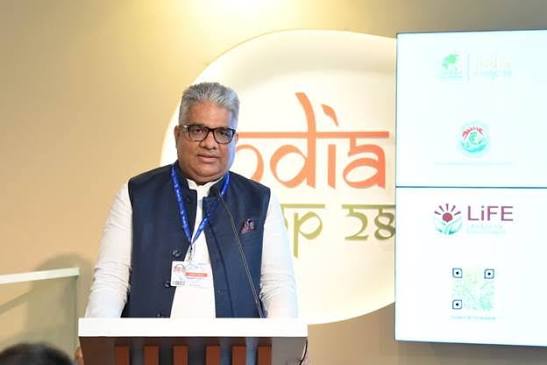

The minister argued that policy alone will not suffice. India, he said, is tying policy to technology and public engagement through flagship programmes such as the National Action Plan on Climate Change, Smart Cities Mission, AMRUT, and Swachh Bharat.
He highlighted the LiFE (Lifestyle for Environment) movement as a behavioural complement to technology-led solutions, urging citizens to adopt small, scalable practices that collectively yield large benefits.
Green Hydrogen, Circular Economy and Bio-Innovation
Dr. Singh showcased Green Hydrogen, circular economy projects and bio-economy initiatives as practical models. He said these offer pathways to decouple economic growth from carbon intensity while creating new livelihoods.
“Critical sectors from energy to manufacturing must align with waste-to-wealth pathways so that the concept of ‘waste’ gradually disappears,” he said, pointing to successful community recycling and used-cooking-oil programmes in Dehradun as local examples that generate income alongside sustainability.
Digital Tools, Geospatial Data and Science-Led Planning
Science and technology, Dr. Singh noted, are central to resilient planning. He cited ISRO’s Earth Observation missions, the National Geospatial Policy (2022), and SVAMITVA drone mapping as instruments that have improved land use planning, disaster preparedness and monitoring.
“Technology gives policymakers actionable evidence but people must own and act on the information,” he said, advocating open geodata and community participation in urban planning.
Youth: A Digital and Creative Force
With over 70% of India under 40, Dr. Singh emphasised youth as the critical audience and agent of change. He urged academics and universities to equip students with interdisciplinary skills and digital tools so they can translate climate science into local solutions.
He recommended social-media campaigns, short digital content, and humour-driven messaging to make climate action relatable, adding that youth-led outreach is essential to convert policy into practice at scale.
Regional Cooperation and Global Partnerships
Dr. Singh called for collective action by Asian nations, pointing to India’s role in international efforts such as the International Solar Alliance (ISA) and the Coalition for Disaster Resilient Infrastructure (CDRI). He urged nations to cooperate on critical technologies, finance and capacity building for a low-carbon future.
“Asia must move from competition to collaboration only then can we secure an equitable and resilient future,” he told delegates.
Education, NEP-led Reform and Interdisciplinary Learning
Drawing attention to the National Education Policy (NEP) 2020, Dr. Singh urged universities to mainstream interdisciplinary subjects such as geography, environmental science and data analytics to develop problem-solving mindsets among students.
He said empowering youth with both knowledge and digital tools is “the most powerful investment” for climate resilience and sustainable urban development.