 India’s Renewable Energy Milestones
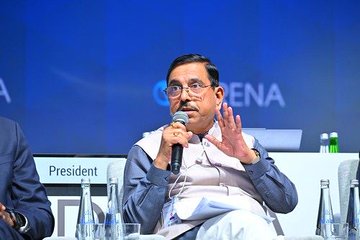
Shri Joshi highlighted India’s progress in renewable energy, noting that the country achieved 50% of its electricity capacity from non-fossil fuel sources in 2025, five years ahead of its Nationally Determined Contribution (NDC) target. India’s total renewable energy capacity now exceeds 266 GW, placing it among the global leaders in renewable deployment.
India is prioritizing reliable and resilient power systems through energy storage solutions, grid modernization, Green Energy Corridors, and innovative bidding mechanisms such as hybrid and round-the-clock renewable energy projects. Domestic manufacturing across solar, wind, batteries, and electrolyzers is being strengthened to support both national self-reliance and global supply chains.
People-Centric Energy Transition
The Union Minister emphasized the people-centered nature of India’s energy initiatives. Under the PM Surya Ghar: Muft Bijli Yojana, 2.5 million households have already benefitted from rooftop solar installations, with a target to reach 10 million households by March 2027. Similarly, under the PM-KUSUM scheme, 2.17 million farmers have benefited from solarization of agricultural feeders and diesel pump replacement.
“Energy transition must become a mass movement, driven by equity and inclusion,” Shri Joshi said, stressing that India’s approach ensures opportunities and sustainable development for all citizens.
Global Cooperation and Investment
Shri Joshi called for stronger multilateral cooperation, technology transfer, low-cost financing, and capacity building to accelerate global renewable energy deployment, particularly in developing countries. India alone is expected to require USD 300 billion by 2030 for renewable generation, storage, green hydrogen, grid infrastructure, and manufacturing, providing ample opportunities for investment.
The Union Minister also met with Dr. Amna bint Abdullah Al Dahak, UAE Minister of Climate Change and Environment, to further India-UAE cooperation on renewable energy, climate action, and clean energy innovation.
India’s Leadership and Vision
India has already added nearly 50 GW of renewable energy capacity in 2025, demonstrating leadership in sustainable energy transition. Shri Joshi reaffirmed India’s commitment to achieve 500 GW of non-fossil fuel installed capacity by 2030 and Net Zero emissions by 2070.
“Stable policies and transparent markets make India one of the most attractive destinations for clean energy investment,” the Minister noted, underlining India’s global leadership in renewable energy deployment and technology innovation.