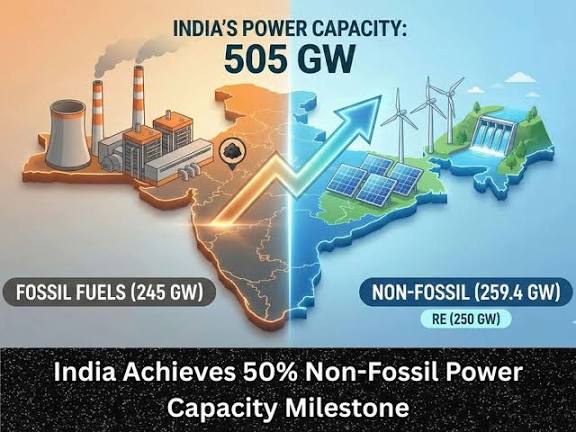
The milestone was formally communicated to Parliament by Minister of State for Power Shri Shripad Naik in a written reply to the Lok Sabha, highlighting India’s steady progress toward the long-term goal of Net Zero emissions by 2070.
 Strong Growth in Renewable Capacity During 2025
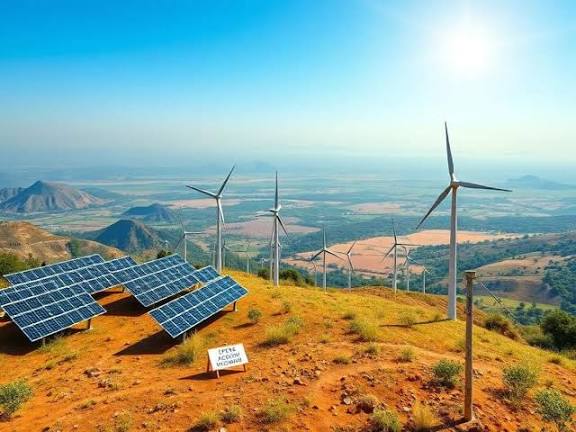
India added an impressive 48,436 MW of renewable energy capacity during 2025 alone. Solar power dominated the expansion, contributing nearly 37,945 MW, followed by wind energy with over 6,347 MW of new capacity. Smaller additions came from bio-power, small hydro, waste-to-energy, and large hydro projects.
This surge reflects the effectiveness of policy support, competitive bidding mechanisms, and growing investor confidence in India’s renewable energy ecosystem. The share of solar power in total installed capacity rose to over 26 percent by the end of 2025, reinforcing its position as the backbone of India’s clean energy growth.
Policy Push Driving the 500 GW Target
The Government of India has undertaken a wide range of initiatives to achieve its ambitious target of 500 GW non-fossil fuel capacity by 2030. Key measures include waiver of inter-state transmission system charges for renewable projects, large-scale competitive bidding, and permission for 100 percent foreign direct investment under the automatic route.
Transmission infrastructure has been strengthened through the Green Energy Corridor scheme, while long-term transmission planning up to 2032 aims to ensure seamless evacuation of renewable power. Solar parks, ultra-mega solar projects, and farmer-centric schemes such as PM-KUSUM have further expanded access to clean energy.
Energy Storage, Hydro and Grid Stability
Recognising the importance of grid stability in a renewable-heavy system, the government has placed strong emphasis on energy storage solutions. Battery Energy Storage Systems with a combined capacity of over 43 GWh are under various stages of implementation with substantial viability gap funding support.
Hydropower and pumped storage projects are also gaining momentum. More than 12,900 MW of hydroelectric projects are under construction, while pumped storage projects totalling nearly 11,870 MW are being developed to support renewable integration and round-the-clock power supply.
Nuclear Energy and Green Hydrogen in Focus
Nuclear energy continues to play a strategic role in India’s clean energy transition. The government has set a target of achieving 100 GW of nuclear power capacity by 2047. Initiatives such as the Nuclear Energy Mission and development of Small Modular Reactors aim to provide reliable, low-carbon baseload power.
Parallelly, the National Green Hydrogen Mission targets production of at least 5 million metric tonnes of green hydrogen annually by 2030, opening new avenues for decarbonising industry, transport and exports.
Balancing Climate Action with Energy Security
India’s energy transition strategy places equal emphasis on affordability, accessibility and security. While fossil fuels still account for a significant share of installed capacity, their proportion is steadily declining as renewables expand at scale.
The government has reiterated that India’s pathway to Net Zero will be inclusive and growth-oriented, ensuring that climate commitments do not come at the cost of development needs.
With over 50 percent non-fossil capacity already achieved, India’s power sector stands at a decisive turning point, offering a strong signal of leadership among emerging economies in the global fight against climate change.