
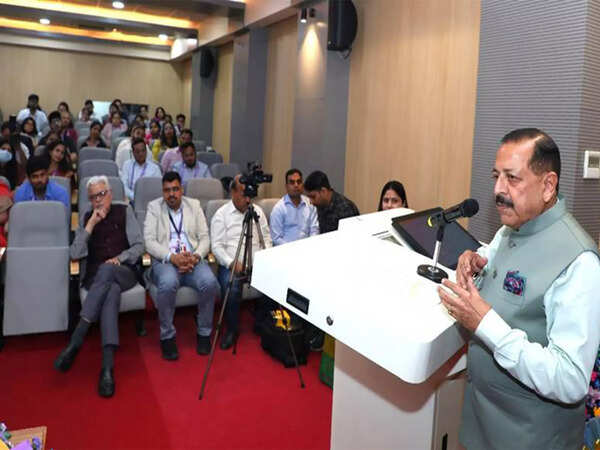
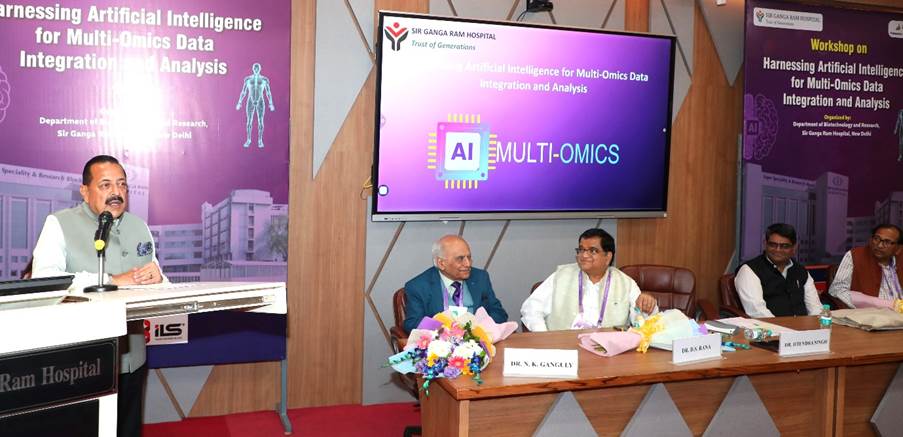
“To achieve global recognition in science and innovation, India must develop a self-sustainable ecosystem that encourages private sector participation and philanthropic support,” Dr. Singh stated during the inauguration of the 3-day Medical Workshop on “Harnessing Artificial Intelligence for Multi-Omics Data Integration and Analysis”. He emphasized that nations recognized for scientific excellence thrive on self-sustaining, innovation-driven models.

Highlighting another success of government-non-government collaboration, Dr. Singh announced India’s first successful indigenous clinical trial for Hemophilia treatment. Conducted at Christian Medical College, Vellore, with Department of Biotechnology support, the trial achieved a 60–70% correction rate and reported zero bleeding episodes. The results, published in the New England Journal of Medicine, underscore India’s growing leadership in advanced biomedical research.
Dr. Singh added that India has already sequenced over 10,000 human genomes, aiming to expand to one million. These efforts, he said, form the backbone of the nation’s future genomic medicine capabilities.
AI Transforming Healthcare and Governance
Artificial Intelligence (AI) is emerging as a transformative tool in India’s healthcare and governance landscape. Dr. Singh highlighted AI-driven hybrid mobile clinics reaching rural and remote areas to ensure quality healthcare access. Additionally, the AI-based grievance redressal system developed by the Department of Administrative Reforms and Public Grievances has achieved a 97–98% weekly disposal rate, improving citizen satisfaction significantly.
Institutions such as Sir Ganga Ram Hospital are pioneering interdisciplinary approaches by combining AI, biotechnology, and genomics to enhance healthcare outcomes. Dr. Singh urged greater collaboration among government agencies, private hospitals, and research institutes to realize the vision of Viksit Bharat @2047.
Building a Self-Reliant Innovation Ecosystem
The Union Minister emphasized the role of the Anusandhan National Research Foundation (ANRF) in fostering a self-sustainable research ecosystem. With an outlay of ₹50,000 crore over five years—₹36,000 crore of which will come from non-government sources—the ANRF represents a paradigm shift in India’s research funding model, aligning domestic science initiatives with global standards.
Dr. Singh concluded that India is entering a new era of self-reliance in biotechnology, AI, and genomic medicine. The convergence of innovation, collaboration, and compassion will shape India’s journey toward a developed nation while establishing its global leadership in science and technology.