
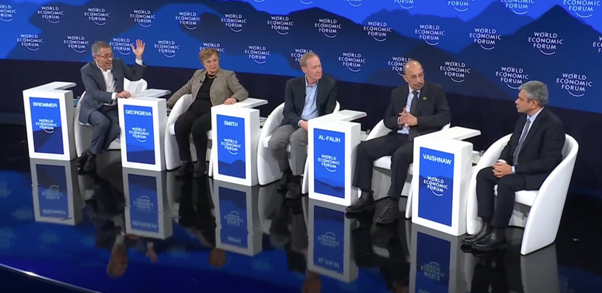
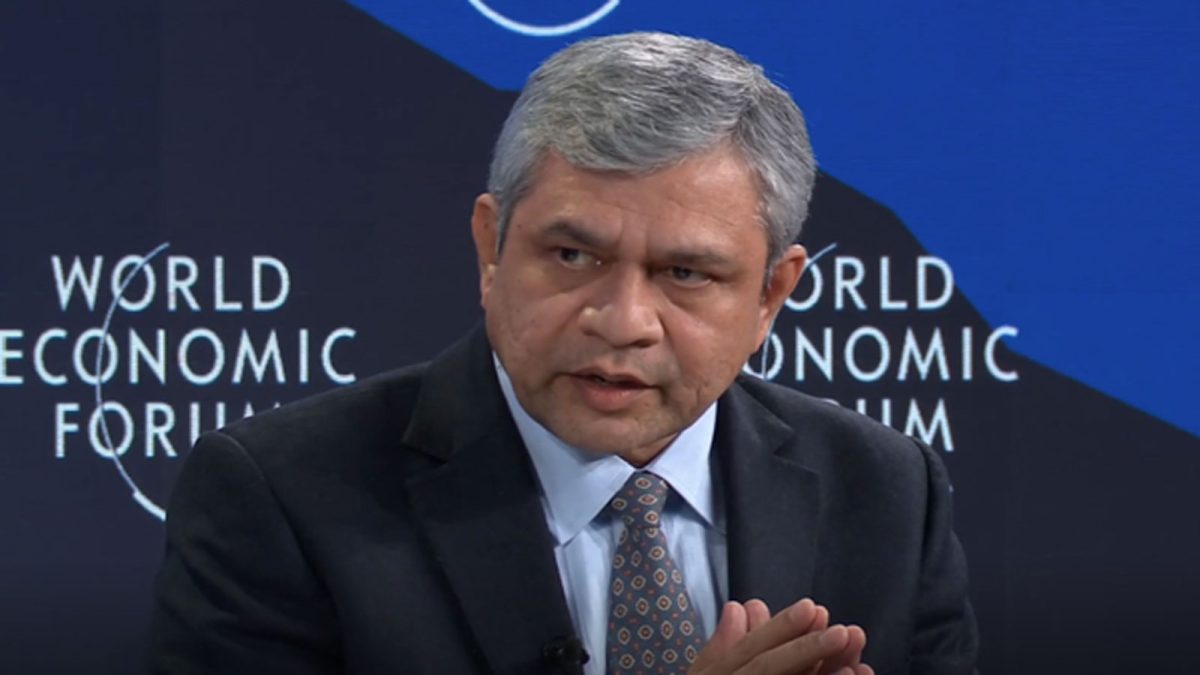

Speaking at the panel moderated by Mr. Ian Bremmer, Shri Vaishnaw highlighted India’s systematic progress across five key AI layers: applications, models, chips, infrastructure, and energy. He emphasized India’s focus on real-world deployment and measurable return on investment rather than creating ultra-large AI models.
“Nearly 95 percent of real-world use cases can be addressed using models in the 20–50 billion parameter range,” Shri Vaishnaw said. He noted that India has developed efficient, cost-effective models deployed across sectors to enhance productivity and efficiency, reflecting the nation’s emphasis on economically sustainable AI adoption.
Democratising AI and Expanding Access
India’s approach to AI includes large-scale diffusion and democratising access to advanced capabilities. Shri Vaishnaw highlighted the empanelment of 38,000 GPUs through a public-private partnership, making them available to students, researchers, and startups at a fraction of global costs. Complementing this, a nationwide AI skilling programme is training 10 million people to leverage AI effectively across domestic and global markets.
Techno-Legal Governance to Tackle Bias
On AI governance, Shri Vaishnaw stressed a techno-legal approach. “Law alone is insufficient. We must deploy technical tools to detect bias, authenticate deepfakes, and ensure safe deployment through mechanisms such as unlearning,” he said. India is actively developing indigenous safeguards to enhance trust and reliability in AI systems.
Global Recognition and Collaboration
Panelists, including IMF Managing Director Ms. Kristalina Georgieva and Microsoft President Mr. Brad Smith, acknowledged India’s emerging role in the global AI landscape. India’s emphasis on diffusion, accessibility, and sovereign capability was recognized as a model for emerging economies seeking balanced and inclusive AI adoption.