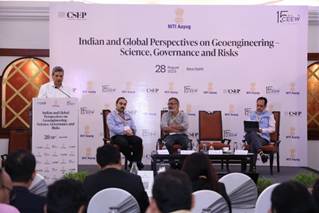
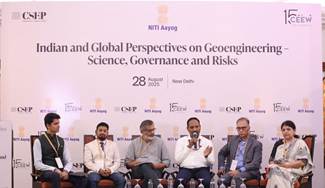
India has taken a step forward in climate discussions with a high-level workshop co-hosted by NITI Aayog, the Council on Energy, Environment and Water (CEEW), and the Centre for Social and Economic Progress (CSEP). The event, held in New Delhi on 28 August 2025, focused on global and Indian perspectives on geoengineering—its science, governance, and risks.
What is Geoengineering?
Geoengineering refers to deliberate large-scale interventions in the Earth’s climate system. The aim is to slow down or reverse climate change. Two main approaches were discussed: Carbon Dioxide Removal (CDR) and Solar Radiation Management (SRM).
- CDR: Removing and storing atmospheric CO₂ through biochar, enhanced rock weathering, ocean-based approaches, and carbon capture with geological storage.
- SRM: Reflecting sunlight back into space using methods such as stratospheric aerosol injection or marine cloud brightening.
While these techniques sound promising, experts stressed the importance of careful research, robust monitoring, and strong governance to manage risks.
 Leaders Emphasize Strategic Research
B. V. R. Subrahmanyam, CEO of NITI Aayog, stressed that India’s development path must remain sustainable. He noted that mitigation should remain the world’s priority, but India also needs to explore “moonshot” technologies to stay prepared.
Dr. Arunabha Ghosh, Founder-CEO of CEEW, highlighted that India must decarbonize without harming its industrial growth. He urged for global collaboration, stressing that climate justice and equity should guide decisions on geoengineering.
Dr. Laveesh Bhandari, President of CSEP, added that geoengineering raises deep questions of science and sovereignty. He underlined the need for democratic oversight, risk assessment, and long-term governance mechanisms tailored for India’s monsoon-driven economy.
Why This Matters for India
India faces growing climate risks—heatwaves, floods, and changing monsoon patterns. While mitigation and adaptation remain top priorities, geoengineering could emerge as a strategic tool. However, any move must consider impacts on agriculture, water security, and livelihoods.
The workshop brought together policymakers, scientists, and international experts such as Prof. David Keith of the University of Chicago. Deliberations underscored the urgency of setting up frameworks for research, risk evaluation, and governance of climate engineering technologies.
Next Steps: Building Governance and Global Cooperation
India’s path forward involves creating strong monitoring, reporting, and verification systems. Transparent governance, public engagement, and international cooperation will be essential. Experts agreed that India must engage early, design institutions for risk management, and ensure democratic oversight in climate-altering technologies.
As the world debates geoengineering, India’s proactive engagement positions it as a responsible global player in shaping the future of climate governance.
Conclusion
Geoengineering is not a silver bullet. But ignoring it could leave India unprepared. By exploring research, risks, and governance now, India can balance its development goals with climate security. The New Delhi workshop marks a key step in this direction.