
India Sets Global Arbitration Ambitions in Motion
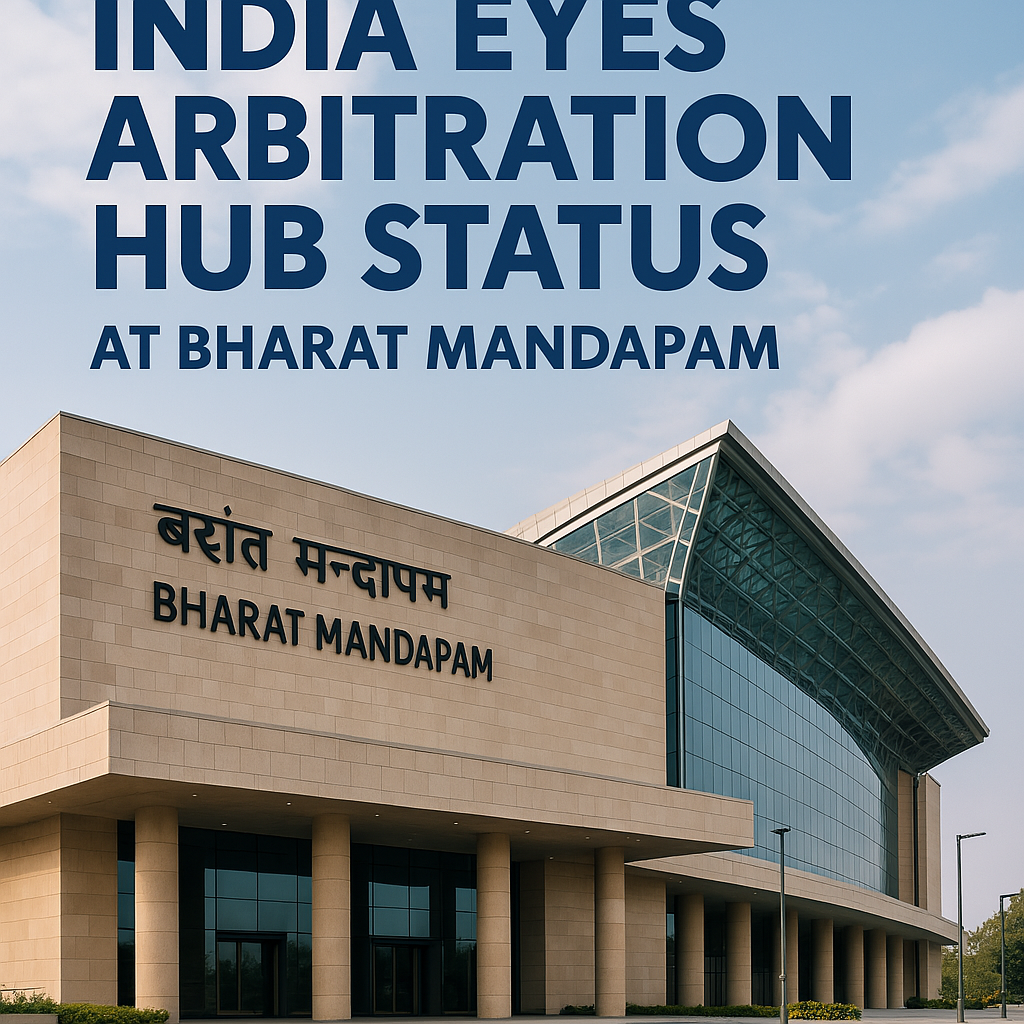
India is on a mission to become the global hub for arbitration, and the momentum was clearly visible at the National Conference on “Institutional Arbitration: An Effective Framework for Dispute Resolution” held on June 14, 2025, at Bharat Mandapam, New Delhi.
Organised by the Ministry of Law & Justice in collaboration with ONGC and the India International Arbitration Centre (IIAC), the event showcased India’s intent to promote structured institutional arbitration over ad hoc systems.

“India Will Become the Arbitration Hub”
Union Minister of State for Law & Justice, Shri Arjun Ram Meghwal, delivered a bold statement during his keynote:
“India will become the arbitration hub.”
He underlined how dispute resolution through arbitration has deep cultural roots in Indian tradition and highlighted the government’s commitment to building India’s legal ecosystem for international commercial arbitration.
Legal Reforms and Institutional Push
Justice Hemant Gupta (Retd.), Chairperson of IIAC, opened the conference by calling for public sector undertakings (PSUs) to move away from ad hoc arbitration and adopt institutional frameworks like IIAC.
Dr. Anju Rathi Rana, Secretary, Department of Legal Affairs, gave a comprehensive overview of the legislative reforms, including digitisation of legal systems and repealing outdated laws. She stressed the significance of embedding IIAC into future PSU contracts.
Industry Perspective: Speed Over Delay
ONGC Chairman Shri Arun Kumar Singh took a firm stand on the importance of timeliness in arbitration.
“Timeliness, not timelessness, should be the ethos of our legal systems,” he said.
His views were echoed by Shri K Moses Chalai, Secretary, Department of Public Enterprises, who stressed that effective arbitration directly enhances governance and economic efficiency.
Four Power-Packed Technical Sessions
The conference was divided into four technical sessions, addressing key areas of arbitration:
1. Strengthening Dispute Resolution in PSUs
Focused on challenges in infrastructure-related disputes and why structured arbitration is crucial. Experts urged capacity-building for PSUs.
2. The IIAC (Conduct of Arbitration) Regulations, 2023
Explained India’s regulatory shift to improve transparency and efficiency. A short film showcased IIAC’s state-of-the-art facilities, a sign of India’s readiness for global arbitration.
3. Best Practices in Arbitral Process
Speakers outlined procedural improvements such as case management, institutional rules, and reducing ambiguities in the arbitral journey.
4. International Learnings and Way Forward
Panelists examined global practices, including emergency arbitration, and discussed the use of AI tools to streamline research and decision-making.
India’s Strategic Arbitration Roadmap
India is strategically positioning the IIAC to match global giants like SIAC (Singapore) and LCIA (London). The Government aims to:
-
Expand institutional arbitration in new states like Madhya Pradesh, Telangana, and Odisha.
-
Launch the offshore arbitration sector, with identified zones in Gujarat and Tamil Nadu.
-
Promote Round-the-Clock Dispute Resolution by integrating storage, digitisation, and AI tools.
The event concluded with the release of the Wind Energy Roadmap and Arbitration Manufacturing Roadmap, symbolising India’s commitment to reform in both legal and industrial sectors.
Conclusion: India’s Legal Vision Takes Shape
As India’s economic influence grows, so does its need for a robust, fast, and reliable arbitration mechanism. With IIAC leading the charge, supported by committed leadership and legal reforms, India is poised to redefine the global arbitration map—not in theory, but in execution.