
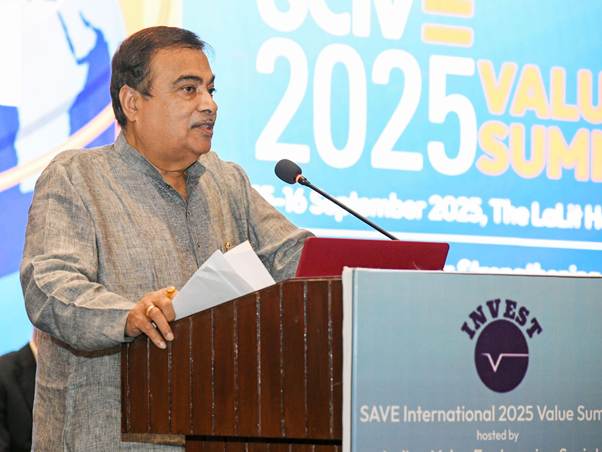
India Surpasses Japan, Eyes Global Leadership
India has already surpassed Japan to emerge as the world’s third-largest automobile market. Gadkari emphasized that global automobile giants are no longer viewing India merely as an assembly base. Instead, many are now exporting vehicles manufactured in India to global markets. He noted that the two-wheeler sector exports more than 50% of its total production, reflecting the country’s increasing global footprint.


A major highlight of the address was India’s leadership in sustainable mobility. Gadkari revealed that hydrogen-powered trucks have already been launched, with pilot projects running across ten routes. Backed by ₹600 crore in government grants, hydrogen infrastructure is being accelerated with the support of leading firms like Tata Motors, Ashok Leyland, Reliance, and Indian Oil.
Beyond hydrogen, India is advancing research on isobutanol and bio-bitumen, alternative fuels that promise to reduce dependence on petroleum and cut emissions. “Our vision is to lead the world in green mobility,” Gadkari said, stressing that the transition to clean energy transport will also create new jobs and business opportunities.
Transforming Road Infrastructure
Gadkari highlighted how infrastructure development has accelerated in recent years. India now boasts the world’s second-largest road network, with reduced travel times on key routes. For example, the travel time from Panipat to Delhi Airport has dropped from three hours to just 35 minutes. Major projects like the Chennai–Bengaluru expressway and the ₹23,000 crore Bengaluru Ring Road are expected to further ease urban congestion and boost economic activity.
Waste to Wealth: Building Roads from Landfills
Emphasizing sustainability, the Minister showcased how over 80 lakh tonnes of waste from the Ghazipur landfill have been used in road construction, reducing the landfill’s height by seven metres. Trials with bio-bitumen made from rice straw have also shown promising results, offering better durability than petroleum-based bitumen while addressing the issue of stubble burning.
Global Partnerships and Innovation
Calling for international collaboration, Gadkari invited global players to bring innovation and technology to India’s infrastructure sector. Areas like precast road construction, tunnel engineering, hydrogen transport systems, and circular economy solutions were highlighted as opportunities for partnership. “We do not have a resource problem. Our roads are monetized, and our revenue is strong. What we need is innovation, technology, and cooperation,” he said.
With this vision, India is not only aiming to dominate the global automobile sector but also redefine it with sustainable practices and advanced technologies.