
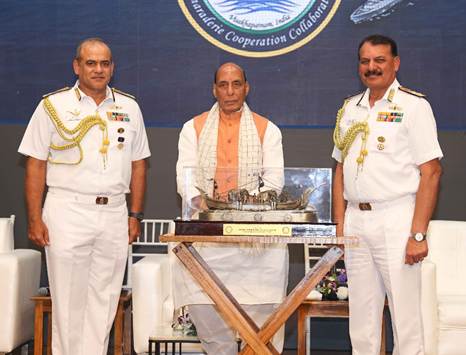
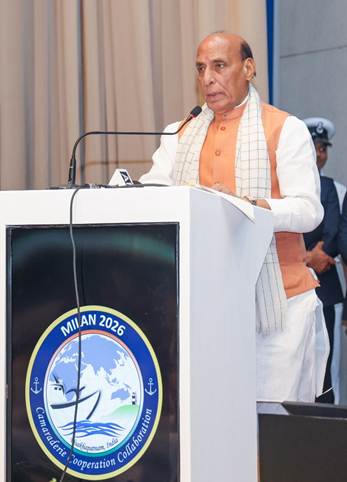

The Raksha Mantri emphasised that the United Nations Convention on the Law of the Sea (UNCLOS) provides a robust legal framework for peaceful maritime coexistence, which can be strengthened further through a comprehensive global naval architecture. Such cooperation would facilitate information sharing, protect critical communication links, and curb criminal activities at sea, alongside protecting national boundaries.
He underlined that platforms like MILAN build professional expertise, mutual trust, and coordinated response capabilities, reinforcing India’s vision of an equitable maritime order and freedom of navigation based on international law.
From SAGAR to MAHASAGAR: India’s Evolving Maritime Vision
India’s maritime strategy has evolved from SAGAR (Security and Growth for All in the Region) to MAHASAGAR (Mutual and Holistic Advancement for Security and Growth Across Regions), reflecting a deeper commitment to engagement with partners in the region and beyond. The exercise underscores India’s role as a trusted “Vishwa-Mitra,” fostering cooperative security, mutual prosperity, and peace in the Indo-Pacific.
“MILAN 2026 enhances interoperability, strengthens operational synergy, and builds trust among navies, ensuring preparedness for complex maritime challenges,” Shri Rajnath Singh said. The exercise also includes sharing professional experiences, joint surveillance, hydrographic support, and humanitarian crisis response exercises.
Harbour and Sea Phases of MILAN 2026
The exercise is conducted in two phases. The Harbour Phase focuses on professional interactions, seminars, bilateral engagements, cross-deck visits, cultural events, and youth officer exchanges. The Sea Phase features advanced operational drills at sea, coordinated maritime security operations, tactical manoeuvres, and communication exercises to enhance mutual trust and operational compatibility among participating navies.
Chief of the Naval Staff Admiral Dinesh K Tripathi described MILAN as a “Maritime Mahakumbh,” highlighting the importance of shared responsibility and collaboration to keep the seas safe, secure, and open. The exercise promotes knowledge sharing, professional competence, and friendship among partner nations.
Strategic Significance
MILAN 2026, among the largest editions of the Indian Navy exercise, showcases India’s leadership in promoting collective maritime security, operational interoperability, and a stable rule-based international order. The participation of 74 nations reflects global confidence in India as a reliable and responsible maritime partner, committed to regional peace, security, and prosperity.