
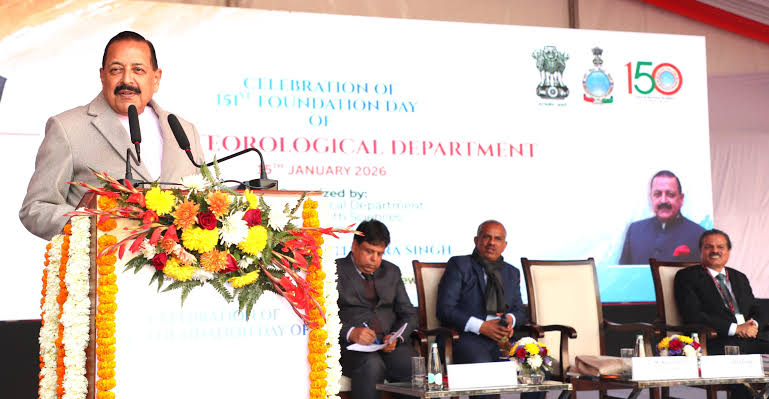

The Minister highlighted that each city will receive 50 AWS units in 2026, providing granular, high-resolution data to predict sudden downpours, thunderstorms, heatwaves, and rapid pressure changes. Dr Jitendra Singh emphasised that such precise, data-driven forecasting is vital for agriculture, aviation, urban planning, and emergency management.
He noted that forecast accuracy has improved by 40–50 per cent, while cyclone track predictions have gained nearly 35–40 per cent precision. Monthly and seasonal forecast errors have reduced from 7.5 per cent to 2.5 per cent, reflecting technological investments and institutional support over the past decade.
Technological Advancements and Infrastructure Expansion
Dr Jitendra Singh underlined the development of micro-radar networks, Doppler Weather Radars, aerosol and solar radiation monitoring systems, and ultra-short-range forecasts that allow citizens to make decisions within a three-hour window. He also highlighted IMD’s leadership in regional meteorological support, aiding Bangladesh, Nepal, Bhutan, and Sri Lanka in disaster management and climate services.
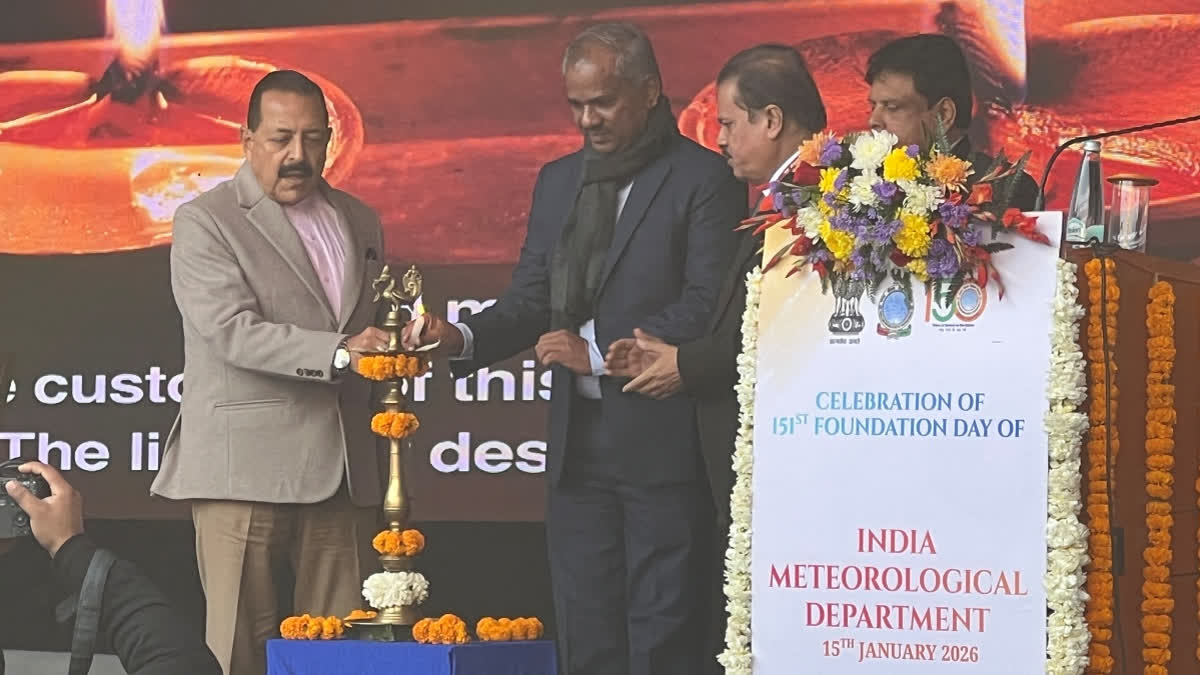
The Minister inaugurated multiple new facilities at the IMD campus, including a Model Observatory, a 3D-Printed Automatic Weather Station, and an Agro-Automatic Weather Station, reflecting India’s emphasis on indigenously developed, cost-effective meteorological technologies.
Mission Mausam and Government Priorities
Dr Jitendra Singh praised the Mission Mausam initiative launched by Prime Minister Narendra Modi as a declaration of the government’s commitment to advanced meteorological science, climate services, and public welfare. The Minister also highlighted IMD’s transition to solar energy, contributing surplus power to the national grid while reducing operational costs.
Centres of Excellence and Future Plans
Concluding his address, the Minister stated that the government plans to establish Centres of Excellence and additional Regional Meteorological Centres to expand IMD’s operational reach. He expressed confidence that as IMD enters its 152nd year, its credibility, accuracy, and public trust will continue to grow, reinforcing India’s disaster preparedness and climate resilience capabilities.