
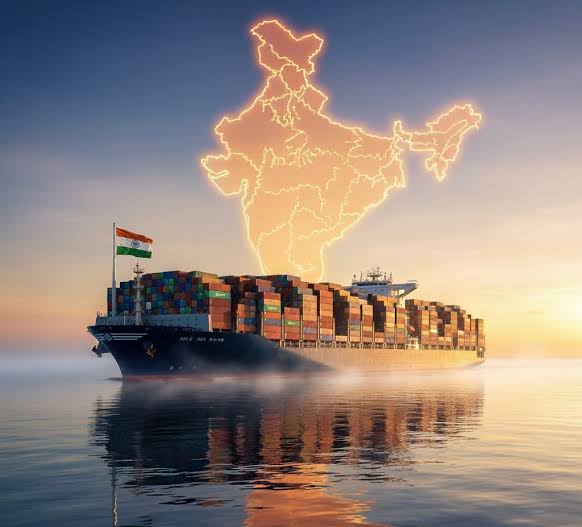

The proposed joint venture includes Jawaharlal Nehru Port Authority (JNPA), Chennai Port Authority, and V.O. Chidambaranar Port Authority. JNPA, India’s largest container gateway, is expected to play a central role in the operational rollout of the shipping line.
Under the planned shareholding structure, SCI and CONCOR will each hold 30% equity. Sagarmala Finance Corporation, the government’s newly launched maritime-focused non-banking financial company, will hold a 20% stake. JNPA will control 10%, while Chennai Port and V.O. Chidambaranar Port will share the remaining 10%.
Addressing a $75 Billion Annual Freight Drain
India currently depends heavily on foreign shipping lines for its container trade. Global players handle nearly 95% of the country’s export-import cargo by volume. As a result, India pays close to ₹6 lakh crore, or approximately $75 billion, every year as freight charges to overseas shipping companies.
Prime Minister Narendra Modi had earlier highlighted this concern during the “Samudra se Samriddhi” event, calling the freight outflow comparable to India’s annual defence budget. The Bharat Container Line is intended to directly address this imbalance.
CONCOR’s Logistics Backbone as Key Enabler
CONCOR’s extensive logistics infrastructure is expected to be the backbone of the new shipping venture. The Navaratna PSU operates 66 terminals across the country, manages around 410 container trains, owns more than 56,000 ISO containers, and has nearly four million square feet of warehousing capacity.
This integrated logistics ecosystem is expected to enable seamless multimodal transport, improve turnaround times at ports, and enhance the competitiveness of Indian exporters and importers.
Boost to Coastal Shipping and Trade Competitiveness
The Bharat Container Line is also expected to give a major boost to coastal shipping, which remains underutilised despite India’s long coastline. Increased coastal cargo movement could reduce logistics costs, decongest roads and railways, and promote more sustainable freight transport.
By strengthening domestic capacity, India aims to gradually build a globally competitive container shipping presence capable of standing alongside international giants such as Maersk, MSC, CMA CGM, Evergreen and Wan Hai.
Aligned with National Maritime Vision
The initiative aligns closely with the government’s broader Sagarmala programme and the National Logistics Policy, both of which seek to enhance port-led development and reduce logistics costs as a percentage of GDP.