
India Anchors Global Efforts on Evidence-Based Traditional Medicine Ahead of WHO Summit
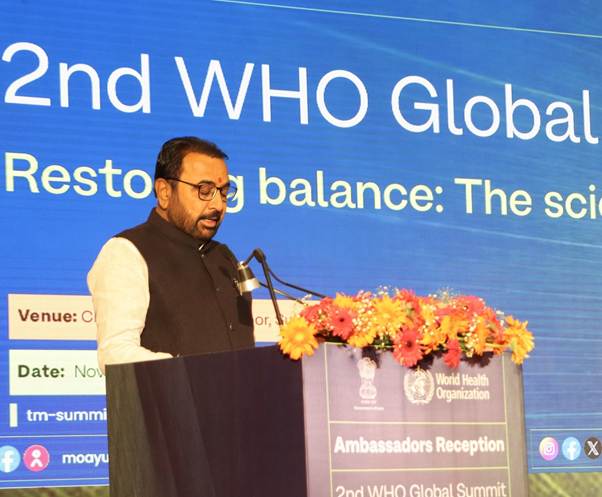

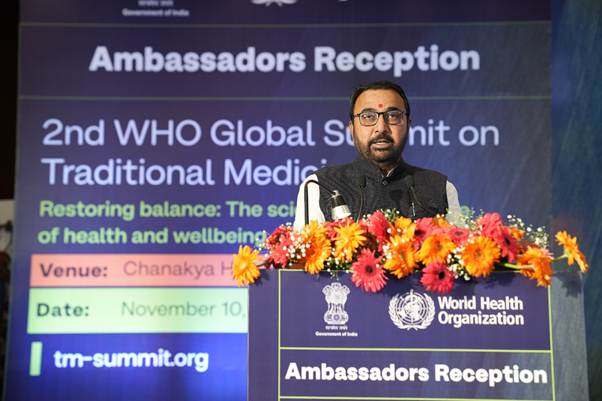
Addressing the gathering, Union Minister of State (Independent Charge) for Ayush and Minister of State for Health and Family Welfare, Shri Prataprao Jadhav, highlighted India’s commitment to building equitable and accessible healthcare through traditional medicine. He emphasised that traditional medical systems represent centuries of community knowledge and cultural heritage, which must now be strengthened through scientific validation and global collaboration.
Shri Jadhav noted that India’s partnership with WHO, including the WHO Global Centre for Traditional Medicine (GTMC) in Jamnagar, Gujarat, has laid a strong foundation for advancing research, quality assurance, and safety standards. He stressed that integrating traditional medicine with modern science can help address global health challenges while ensuring universal access.
Legislative and Institutional Support
Vaidya Rajesh Kotecha, Secretary, Ministry of Ayush, underlined the importance of global alignment around holistic health systems. Referring to the Summit’s theme, “Restoring Balance: The Science and Practice of Health and Wellbeing,” he said the dialogue would focus on strengthening standards, advancing research, and ensuring quality control across traditional medicine systems worldwide.
He added that India’s efforts are rooted in evidence-based policymaking, supported by pharmacovigilance frameworks and international cooperation. These initiatives aim to ensure that traditional medicine is safe, effective, and accessible to people across regions.
WHO’s Vision: Traditional Medicine for Health for All
Dr Poonam Khetrapal, Regional Director Emeritus, WHO South-East Asia Region, described traditional medicine as integral to achieving the global goal of Health for All. She highlighted that over 170 WHO Member States report the use of traditional medicine, reflecting its widespread relevance.
She also pointed to global initiatives such as the Traditional Medicine Global Library and the GTMC in Jamnagar as critical steps toward evidence-informed and people-centred healthcare. According to her, these platforms will support research, data sharing, and informed policy decisions.
India’s Diplomatic and Global Role
Ambassador Sibi George, Secretary (West), Ministry of External Affairs, emphasised India’s growing role in shaping global frameworks for traditional medicine. He said the upcoming WHO Summit reflects increasing international recognition of traditional medicine as part of universal health coverage.
He noted that the Ministry of Ayush has strengthened these systems through research collaborations, safety monitoring, and engagement with global partners. India’s diplomatic outreach, he said, has helped position traditional medicine as a credible and scientific component of global health systems.
Roadmap for the WHO Global Summit
Providing a broader perspective, Dr Shyama Kuruvilla, Director of the WHO Global Traditional Medicine Centre, outlined the Summit’s objectives. She said the event will align with the Global Traditional Medicine Strategy 2025–2034, adopted by the World Health Assembly, and will focus on innovation, sustainability, and evidence-based integration.
Ms Monalisa Dash, Joint Secretary, Ministry of Ayush, briefed delegates on the Summit’s thematic tracks, expected high-level participation, and planned ministerial roundtables. She encouraged diplomatic missions to facilitate active engagement from their respective governments.
Renewed Commitment to Global Collaboration
In her closing remarks, Dr Catharina Boehme, Senior Advisor to the WHO Director-General and Officer-in-Charge, WHO SEARO, reiterated that traditional medicine is central to building inclusive and affordable health systems. She urged countries to support high-level participation at the Summit to strengthen global cooperation.
The Ambassadors’ Reception concluded with a shared commitment to advancing evidence-based traditional medicine through international partnerships. As New Delhi prepares to host the global summit in December, India’s leadership signals a growing global consensus on integrating traditional knowledge with modern science for sustainable and inclusive healthcare.